Remote Control Integration for Mobile Elevators
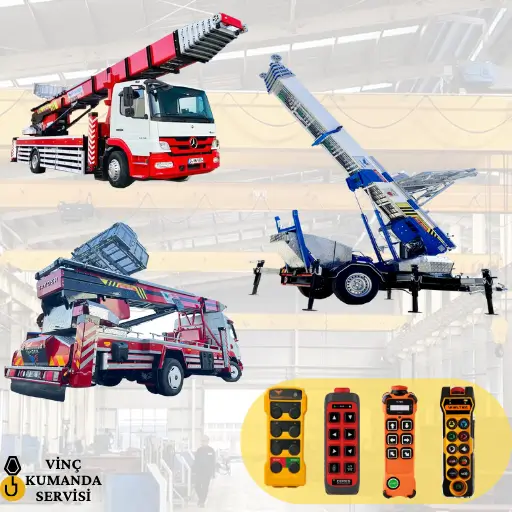
Vehicle-mounted mobile elevators and facade transport systems are critical operational vehicles where wind load, hydraulic pressure, and outrigger dynamics must be managed instantly. In legacy mobile elevators, the operator is forced to stand by the manual hydraulic valves next to the truck. This restricts the operator’s line of sight to the balcony or roof and significantly increases the risk of workplace accidents.
At Vinç Kumanda Servisi, we modernize this manual and hazardous structure in your mobile elevators with wireless crane remote control technologies. You can contact our expert engineering team to step away from the vehicle, move to the point where you have the clearest view of the load, accelerate your operations, and transform your mechanical hydraulic systems into flawless electronic operations. We proudly provide continuous Remote Technical Support for our global clients.
How to Convert from Manual Hydraulic Valve to Remote Control?
The biggest challenge for mobile elevator owners is figuring out how to transition to a remote control system without completely replacing the old mechanical hydraulic valves on their vehicles. Replacing the entire hydraulic block with electronic valves requires a massive procurement budget. However, with the innovative solutions engineered by our Mechanical Engineers, this process becomes highly cost-effective and secure.
Thanks to the Hydro-Lever Manual Hydraulic Valve Conversion Kit, which we integrate directly over the existing manual levers, your mechanical levers are equipped with an electromechanical actuator without compromising the system’s originality. This kit converts the signal from the receiver unit into a physical push/pull force, moving the hydraulic lever on your behalf. Through this seamless conversion, you retain the ability to use your old manual levers in emergency scenarios while integrating a state-of-the-art, Heavy-Duty remote control into your system.
How is a Remote Control Used in Mobile Elevators?
Mobile elevators are vehicle-mounted systems primarily used to transport goods to high-rise buildings during logistics and relocation operations. They ensure that items are transported safely through points like windows or balconies.
Integrating a remote control into mobile elevators elevates the functionality and safety of these systems to international standards. It empowers operators to manage the system with ultimate precision and safety while expediting the transportation process. Remote control systems govern the critical movements of mobile elevators through the following core functions:
1. Startup, Stabilization, and Positioning
- Initial Controls with Remote: The operator configures the platform’s setup angle using the remote control buttons. This ensures the platform maintains a stable center of gravity on solid ground. The remote allows the operator to actively observe ground slopes or physical obstacles and determine the most optimal outrigger position.
- Height Adjustment of the Platform: The platform is elevated to perfectly align with the target floor’s balcony or window. The operator utilizes the remote’s Dual-Speed control capabilities to prevent any shaking or instability during the ascent.
2. Transportation Process
- Cargo Loading: The elevator’s platform is lowered to the ground to load the payload securely. The operator executes a slow, stabilized lifting process via the remote to maintain load balance, ensuring the platform does not tilt laterally.
- Precise Routing: When transporting large or heavy industrial loads, the platform requires millimeter-precision alignment. The operator utilizes the directional buttons on the remote control to navigate the platform left, right, up, or down, finding the exact trajectory to avoid structural obstacles.
3. Safety Operations
- Emergency Stop (E-Stop): In the event of an anomaly—such as platform instability, load shifting, or sudden mechanical failure—the operator can instantly halt all active movements by pressing the E-Stop button. This CE Certified safety feature prevents critical accidents and payload damage.
- Operator Safety: The wireless system completely eliminates the need for the operator to stand near the hazardous moving parts of the platform. The operator commands the workflow from a designated safe zone with maximum visibility.
4. Post-Transportation Procedures
- Closing the Platform: The operator smoothly lowers the platform to its default position and securely folds the mechanical parts onto the truck chassis using the remote. The precision speed controls prevent mechanical wear and tear.
- System Checks: The operator remotely verifies that the mobile elevator is fully secured and all safety protocols are locked in place, ensuring a long operational lifespan for the equipment.
What Should Be Considered When Choosing a Remote Control for Mobile Elevators?
To ensure uninterrupted procurement and operational efficiency, you must consider the following technical criteria when selecting a remote control system for your mobile elevators:
Durability
Industrial remote controls must withstand harsh weather conditions. We mandate IP65/IP67 Protection Class models for mobile elevators operating in open areas, guaranteeing waterproof and shock-resistant performance.
Frequency Range
The signal transmission range and frequency band must be robust enough to maintain a secure, uninterrupted connection across expansive operational environments.
Multi-Functionality
You must procure a model that natively supports all dynamic functions of the mobile elevator, including lifting, lowering, dual-speed control, and immediate emergency stops.
Ergonomic Design
Heavy-duty does not mean heavy weight. We supply lightweight, highly ergonomic designs that minimize operator fatigue during extended operational shifts.
Remote Control Selection Criteria for Mobile Elevators
Equipment deployed outdoors, exposed to direct sunlight or heavy rain, must feature significantly higher resilience tolerances compared to standard indoor factory equipment.
- IP65 and Above Sealing: Prevents sudden downpours, snow, or abrasive street dust from penetrating the housing, oxidizing the mainboard, and causing short circuits.
- Proportional (Precise) Control Compatibility: Guarantees that the operational speed is smoothly decelerated without sudden jerks as the payload approaches the building structure, preventing cargo drops.
- Strong Antenna and Frequency Range: Secures uninterrupted communication between the truck base and the basket, preventing signal loss even when extending up to the 20th floor.
Outdoor and Vehicle-Mounted Control Failures (Troubleshooting)
A mobile elevator malfunction during a logistics operation means the entire crew remains idle in the field. Below are the primary technical issues and troubleshooting steps for hydraulic conversion kits and remote controls:
- Remote Transmits Command But Hydraulic Lever Fails to Engage: Power may not be reaching the actuator mechanism within the Hydro-Lever conversion kit. Check the main supply fuse routed from the vehicle’s battery and inspect the valve connection sockets.
- Signal Loss at Maximum Boom Extension: The receiver antenna mounted on the truck chassis might be obstructed by the metal booms (Faraday cage effect). Relocate the antenna to a higher, unobstructed point on the vehicle, such as the cabin roof.
- System Initiates Auto-Shutdown (E-Stop Active): The transmitter battery voltage has dropped to critical levels, forcing the system into a Fail-Safe mode. Replace the batteries or insert a fully charged spare battery pack.
Wireless System vs. Manual Operation ROI (Return on Investment) Analysis
Upgrading from manual levers to a wireless architecture (Hydro-Lever Kit + Remote Control) is a high-yield investment that pays off rapidly for logistics and construction enterprises. In legacy setups, one worker operates the hydraulic valves near the truck while a second worker spots from the balcony, shouting manual commands. This flawed communication loop frequently results in payloads crashing into building facades, leading to costly client compensation claims.
By implementing a remote control system, a single operator navigates the load independently, walking alongside the payload with 100% visual clarity. This instantly reduces workforce requirements by one personnel per vehicle while entirely eliminating property damage risks. For an actively deployed mobile elevator, the combined savings in labor and prevented damages completely amortize the remote control investment within 1 to 2 months.
OHS (Occupational Health and Safety) Protocols in Mobile Elevator Operations
Passing pedestrians, overhead high-voltage power lines, and unpredictable wind shears are constant risk factors during exterior lifting operations. An operator confined to the base of the vehicle managing manual levers simply cannot monitor overhead electrical hazards or shifting loads.
Wireless systems allow the operator to establish a 15-20 meter safety perimeter, securing a wide-angle view of the boom, power lines, and the building structure simultaneously. Equipped with PL-d / SIL2 safety relays, our systems empower the operator to trigger the E-Stop button during an unexpected wind gust or hydraulic hose rupture, locking down the entire mechanism in milliseconds to prevent catastrophic accidents.
Frequently Asked Questions (FAQ)
We have compiled the critical engineering details most frequently requested by fleet managers looking to retrofit their manual hydraulic mobile elevators with wireless control technologies:
1. My truck’s elevator uses old-style manual levers. Can a remote control be installed on this?
Yes, absolutely. We deploy the Hydro-Lever Manual Hydraulic Valve Conversion Kit, adding electromechanical actuators directly over your existing hydraulic block. This makes your current system fully compatible with a remote control without the need to dismantle the original valves.
2. If the remote malfunctions after the conversion kit is installed, can I still use the manual levers?
Yes. Our engineered conversion kit does not restrict the physical mechanics of your manual levers. Should your remote control run out of battery or face an electronic fault, you can simply walk over to the truck and manually operate the hydraulic levers to complete the operation safely.
3. Should I procure a 4-button or 6-button remote for my mobile elevator?
Mobile elevators structurally operate on 3 primary axes (6 movements): boom lifting/lowering, extending/retracting, and right/left rotation. To seamlessly execute all these functions, we strongly recommend our 6-button industrial remote control models as the standard B2B configuration.
4. Will the remote signal clash with other vehicle keys or radio frequencies on the street?
No, signal interference is technically impossible. Our remote controls operate utilizing 2.4 GHz FHSS (Frequency Hopping Spread Spectrum) or encrypted UHF bands. Every single unit possesses a unique security identification code (ID), actively rejecting signal overlap from other cranes, vehicle remotes, or localized Wi-Fi networks.
5. Will the remote get damaged if I operate the elevator during heavy winter rain or snow?
Our industrial-grade wireless transmitters feature a stringent IP65 Protection Class rating. The internal electronic circuit boards are fully shielded against fluid ingress and particulate matter. They will continue to function flawlessly in heavy rain, snowfall, or severely dusty construction environments.
6. Will the installation process on the truck damage the vehicle’s electrical system?
No. Our specialized technical team integrates the receiver unit and the conversion kit directly into the vehicle’s 12V or 24V battery architecture using entirely independent relays and safety fuses. We strictly bypass the vehicle’s ECU (Electronic Control Unit) and original wiring harness to guarantee zero electrical interference.
Contact Us for Your Remote Control Needs in Mobile Elevators
As Vinç Kumanda Servisi, we engineer and distribute premium remote control systems for your mobile elevator fleets. Through our comprehensive sales, technical integration, and post-sales support, we are dedicated to optimizing the safety and efficiency of your global operations.
Whether you require system procurement, technical troubleshooting, or spare parts, we offer robust solutions backed by our International Warranty and Global Shipping capabilities. Contact our Mechanical Engineers today to determine the optimal remote control architecture for your mobile elevators and secure your B2B quotation!
Saray Mah. Kahramankazan, Ankara / TÜRKİYE
(Same-Day Global Dispatch)
- • Industrial System Procurement
- • Technical Integration Support
- • Original Spare Parts Logistics
- Mon - Sat: 08:30 - 18:30
- (Emergency Support via WhatsApp)