Why Use Wireless Crane Remote Control? Benefits, Drawbacks and How It Works
The short answer: to move the operator out of the hazard zone, improve sightlines to the load, and increase operational efficiency with measurable results. Wireless crane remote control systems are displacing traditional pendant controls across industrial operations — not only for comfort reasons, but because of quantifiable safety and productivity gains. This guide covers how wireless crane remote systems work technically, what the concrete advantages are, where the limitations exist, and how they compare directly to pendant controls — so you can evaluate the switch based on facts rather than general claims.
Get in Touch for All Your Requirements
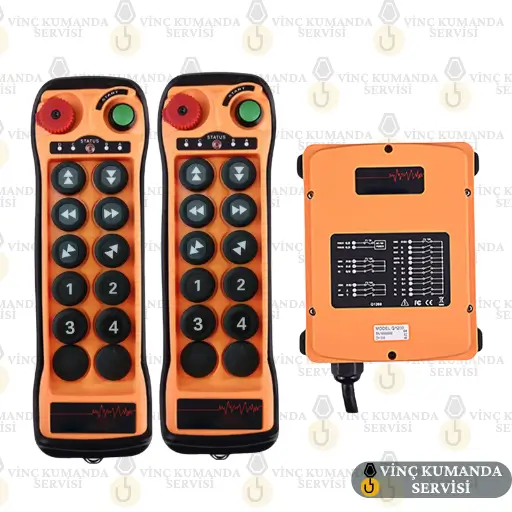
How Wireless Crane Remote Controls Work
A wireless crane remote control system consists of two units: a transmitter (the handheld control) and a receiver (mounted on the crane). When the operator presses a button or moves a joystick, the transmitter sends an encrypted data packet over the radio frequency channel. The receiver decodes this packet and initiates the corresponding crane movement. The entire sequence completes in under 50 milliseconds — fast enough that the operator perceives the response as instantaneous.
Frequency Technology and Pairing
Modern systems operate on 433 MHz or 868 MHz frequency bands. These frequencies are preferred for industrial environments because they provide good obstacle penetration and are designated as licence-free under ETSI short-range device regulations. Furthermore, FHSS (Frequency Hopping Spread Spectrum) technology continuously changes the operating channel in milliseconds, minimising interference risk from other wireless devices on the same site.
To prevent cross-interference, each transmitter-receiver pair is locked with a unique pairing code at the factory. Consequently, no other transmitter can activate a crane’s receiver — even if it operates on the same frequency band. This pairing architecture is the technical basis for the safety claim that wireless crane remotes do not send incorrect commands to adjacent cranes.
Advantages of Wireless Crane Remote Control Systems
Wireless crane remote systems offer concrete, measurable advantages over pendant controls across five areas: cost, safety, efficiency, profitability, and diagnostic capability. Each is worth examining specifically, because the business case for switching is strongest when all five are evaluated together rather than in isolation.
Cost Advantages
Wireless systems eliminate the cable conduit installation, wiring labour, and fixed cable routing that pendant installations require. As a result, installation time and cost are lower for new deployments. Over the operational life of the system, cable wear and replacement costs — a significant maintenance line item on high-cycle pendant systems — drop to zero. However, the initial purchase cost of a wireless transmitter-receiver set is higher than an equivalent pendant. The TCO advantage of wireless typically becomes positive within 2–3 years in high-cycle applications.
Operator Safety
The most significant safety benefit of wireless crane control is operator positioning freedom. With a pendant, the operator must remain within cable length of the crane — which often places them beneath the load or in the crane travel path. Wireless control allows the operator to stand at the safest available position regardless of crane location. Consequently, the two most common pendant-related incident types — the pendant cable catching on a moving load, and the operator remaining in the load travel path — are eliminated entirely.
IEC 60204-32 defines operator safety as a fundamental requirement for crane control systems. Wireless systems with CE and IP65 certification meet this standard while also providing standard protection against dust and water splash — addressing both the electrical safety and the environmental durability requirements simultaneously.
Operational Efficiency
Because the wireless operator moves with the crane, they maintain continuous direct sightlines to the load and the landing point. As a result, they no longer need a signal person or second crew member to guide the load to its destination. Field feedback consistently indicates that this capability reduces average cycle time per lift by 15–25%. Over a full production shift, this improvement compounds into measurable throughput gain.
Operational Profitability
A single wireless-equipped operator can complete tasks that previously required two or three people. This directly reduces labour cost per lift. Furthermore, the reduction in incident-related production stoppages improves both uptime and insurance cost profiles — two financial outcomes that are difficult to quantify in advance but consistently appear in post-implementation reviews.
Diagnostic Data and Preventive Maintenance
Modern wireless crane remote controls generate operational data that pendant systems cannot produce: fault code logging, operating hour counters, and load weight tracking. This data feeds directly into preventive maintenance programmes — enabling scheduled intervention before failure rather than reactive repair after breakdown. Consequently, unplanned downtime and emergency repair costs reduce in proportion to how consistently the diagnostic data is monitored and acted upon.
Honest Assessment: Limitations of Wireless Crane Remote Controls
Every technology has limitations, and wireless crane remote systems are no exception. Understanding these constraints clearly leads to better specification decisions and fewer surprises after installation.
- Battery dependency: Rechargeable battery systems can deplete unexpectedly on low-use cranes (ISO class A–B) if charging discipline is not maintained. However, the solution is straightforward: station-mounted charging units and a spare charged battery protocol eliminate this risk in practice.
- Handheld unit durability: The transmitter is a handheld device exposed to drops and impact. IP65-rated units with rubber-over-moulded housings and wrist lanyards significantly reduce damage frequency. In our service experience, the majority of handheld unit failures are mechanical in origin — not electronic circuit failures — and are largely preventable through simple handling protocols.
- Frequency restrictions in some markets: In most European and internationally aligned markets, 433 MHz and 868 MHz are licence-free for industrial use. However, verify local frequency regulation for deployments in markets outside standard ETSI jurisdiction.
Pendant vs Wireless Crane Remote: Direct Comparison
Pendant systems remain common. However, wireless systems offer clear advantages in operator positioning, safety, and data capability. The comparison below summarises the key differentiators — for a more detailed technical analysis, see our wired vs wireless crane remote control guide.
| Criterion | Pendant (Wired) | Wireless Remote |
|---|---|---|
| Operator Position | Constrained to cable length | 50–100 m, freely positioned |
| Safety Risk | Cable catch, load zone exposure | Operator outside hazard zone |
| Maintenance | Cable and connector wear | Battery and handheld unit |
| Diagnostic Data | None or very limited | Fault codes, run hours, load tracking |
| Installation Flexibility | Fixed cable routing required | No cable infrastructure, easily relocated |
Conclusion: What to Know Before Making the Switch
Wireless crane remote control is a measurably better solution than pendant control for most industrial crane applications — specifically in terms of operator safety, single-person operation capability, and long-term maintenance cost. For high-cycle, large-span crane operations, the business case is compelling and the TCO advantage over pendant is typically visible within 2–3 years.
However, wireless is not universally the right choice. For small, fixed-position cranes in low-traffic environments where EMI is a specific concern, wired pendants remain reliable and cost-effective. The specification decision should be based on the actual operating environment — not on a general preference for newer technology. For the complete selection framework, see our crane remote control buying guide.
Frequently Asked Questions
How far does a wireless crane remote control operate?
Most industrial models provide 50–100 m effective range in enclosed environments and up to 200 m in open-area conditions. However, metal structures and concrete walls reduce the effective range below the nominal datasheet figure. In enclosed factories, 30–50 m is a practical planning estimate. Specify a model with nominal range at least 50% above your maximum required operating distance to maintain reliable coverage throughout the working area.
Is wireless crane remote control safe — can it send incorrect commands?
In modern systems, each transmitter-receiver pair is locked with a unique encrypted pairing code — no other transmitter can activate the receiver, even on the same frequency band. Furthermore, when the signal is lost for any reason, the system automatically enters Safe Stop mode and arrests all crane motion. This fail-safe response is a requirement of IEC 60204-32 and ISO 13849-1 and must be verified through certification documentation before purchasing.
How often does the battery need charging?
In intensive shift use — up to 8 hours of active operation — most industrial models require one charge per day. For low-frequency crane use, leaving the remote in a station charger between uses eliminates the risk of finding a flat battery when the crane is needed urgently. A charged spare battery on site is standard operational practice for any critical crane application.
Is switching from pendant to wireless crane control difficult?
The receiver unit is integrated into the crane’s existing control panel — the crane’s motors and brake circuits are not modified. For an experienced installation team, the conversion typically takes between half a day and one full working day. The existing crane does not need to be replaced or significantly modified. See our crane remote control installation service for details.
Which crane types can use wireless remote controls?
Wireless remote controls are applicable to all industrial crane types — overhead bridge cranes, gantry cranes, jib cranes, tower cranes, and mobile cranes. The selection criteria — transmitter motion count, IP rating, frequency band, and certification level — vary by application and operating environment, but the technology is compatible with all standard crane types. Correct specification requires knowing the crane’s ISO duty class and the environmental conditions at the installation site.
What diagnostic data does a wireless crane remote control provide?
Modern wireless crane remote controls log fault codes with timestamps, cumulative operating hours, and — in advanced models — load weight data per lift cycle. This data supports preventive maintenance scheduling, identifies developing faults before failure, and provides documentation for OHS compliance audits. Consequently, facilities that integrate crane remote diagnostic data into their maintenance programmes consistently experience lower unplanned downtime than those running reactive maintenance only.
What is FHSS and why does it matter for wireless crane remotes?
FHSS (Frequency Hopping Spread Spectrum) continuously changes the operating channel within the frequency band rather than transmitting on a fixed channel. This makes the signal highly resistant to interference from other wireless devices operating on the same site. In facilities with multiple active crane remotes, welding equipment, or motor drives, FHSS is the technology that maintains reliable signal quality where fixed-frequency systems would experience interference-induced command delays or dropouts.
Does wireless crane remote control require any regulatory approval?
CE-certified systems operating on 433 MHz or 868 MHz bands do not require individual frequency licences in EU-aligned markets — both bands are licence-exempt under ETSI short-range device regulations. However, the CE Declaration of Conformity and installation documentation should be maintained on file for OHS inspections. In classified explosive atmosphere zones, ATEX certification is additionally required on top of CE — these are separate certification requirements addressing different regulatory frameworks.
Contact Vinç Kumanda Servisi
Ready to evaluate a wireless crane remote control for your installation, or looking to convert an existing pendant system? Contact Vinç Kumanda Servisi via WhatsApp at +90 532 546 84 62, email us at info@vinckumandaservisi.com, or visit our contact page for a tailored recommendation.