Overhead Crane Remote Control Options: All Types Compared by Motion Count and Application
Selecting the right wireless crane remote control for an overhead or bridge crane directly affects operator safety, crane service life, and production efficiency. From 2-motion to 12-motion configurations and proportional joystick systems, each type serves a specific application profile — and the correct choice depends on a few technical criteria that are straightforward to verify once you know what to look for. This guide covers every crane remote control type available for overhead and bridge crane applications, matched to the operating scenarios where each is the correct specification.
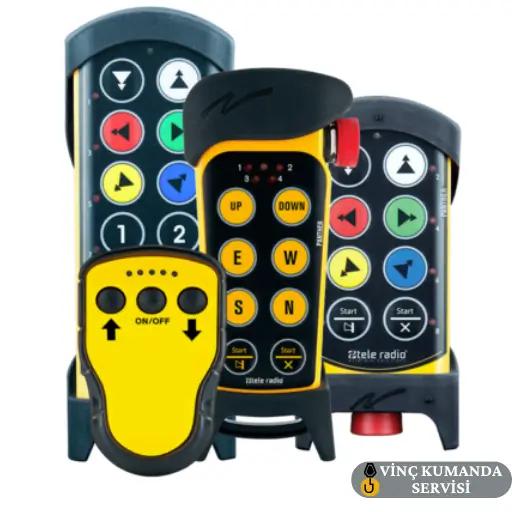
Quick Reference: All Types at a Glance
The table below provides an overview of all overhead crane remote control types. Each is covered in detail in the sections that follow.
| Type | Control Axes | Speed Mode | Typical Application |
|---|---|---|---|
| 2-Motion | Hoist up/down | Single speed | Fixed-position overhead crane |
| 4-Motion | + Bridge travel | Single / Dual speed | Bridge crane — medium scale |
| 6-Motion | + Trolley travel | Single / Dual speed | Production lines, metalworking |
| 8-Motion | Full 3-axis | Dual speed (standard) | Assembly + transfer combined |
| 10-Motion | Full 3-axis + auxiliary | Dual speed + special commands | Double drum, large bridge crane |
| 12-Motion | Full 3-axis + extended auxiliary | Dual speed + multiple commands | 20+ tonne double-girder, shipyard |
| Proportional | Full 3-axis | Stepless (analogue) | Foundry, mould, chemical, nuclear |
2-Motion: Vertical Lift Only
A 2-motion crane remote control commands only the hoist up and hoist down functions — the vertical movement of the crane hook. It does not provide any horizontal crane travel control. Consequently, it is appropriate only for fixed-position installations where the crane does not need to travel and the operator’s position does not change during operation. Fixed-station overhead cranes in warehouses, single-point lift applications, and low-budget installations where bridge travel is not required are the correct application scope.
When 2-Motion Is the Right Specification
2-motion is the correct specification when: the crane lifts and lowers at a fixed point with no lateral movement requirement; the operator position is fixed; and budget is a primary constraint. However, it is critical to verify that the crane application will not require bridge travel in the future — adding bridge travel control later requires a complete remote control system replacement, not a simple button addition.
4-Motion: Adding Bridge Travel Control
A 4-motion remote adds forward and backward bridge travel commands to the 2-motion hoist function — providing control of the bridge’s longitudinal movement along the runway rail. This configuration covers the majority of standard bridge crane applications where the operator needs to position the crane along the length of the building but does not require lateral trolley positioning. Large warehouses, precast concrete production sites, and longitudinal positioning applications are the primary use cases.
Frequency and Interference Considerations
4-motion systems — like all configurations in this guide — operate on 433 MHz or 868 MHz frequency bands. Both are licence-free under ETSI short-range device regulations and designed to minimise interference risk in industrial environments. For facilities with multiple active crane remotes operating simultaneously, FHSS (Frequency Hopping Spread Spectrum) technology is the correct specification regardless of motion count.
6-Motion: Full Three-Axis Control
A 6-motion remote adds left and right trolley travel commands to the 4-motion configuration — providing full control across all three crane movement axes: hoist up/down, bridge travel forward/back, and trolley travel left/right. Consequently, the operator can position the hook at any point within the crane’s full coverage area. This is the standard configuration for production floor bridge cranes, metalworking facilities, and machine assembly lines where precise load placement is required in both longitudinal and lateral directions.
Why 6-Motion Is the Production Floor Standard
In a large production hall where loads must be moved to specific points across the floor area, 4-motion control is insufficient — it moves the crane longitudinally but not laterally. As a result, the operator cannot position the load to any arbitrary point within the crane’s coverage zone. A 6-motion system resolves this completely. Furthermore, 6-motion is typically the most cost-effective entry point for full-coverage overhead crane control — 8-motion adds dual speed capability but does not add new movement axes.
8-Motion: Full Axis Control with Dual Speed
An 8-motion remote provides the same three-axis full coverage as a 6-motion system, but adds a dual-speed mode for every motion direction. Each axis can be operated at slow speed (typically 25–30% of full speed) for precision positioning, or at full speed for rapid material transfer. Consequently, the same crane can be used for both fine-placement assembly operations and high-speed bulk material transfer within the same production shift — without any system reconfiguration.
Mechanical Benefits of Dual Speed
The dual-speed function reduces mechanical load on the crane’s brake and motor systems as well as providing operational precision. Specifically, the slow-speed setting allows the operator to bring a heavy load to its exact landing position without the abrupt stops that full-speed deceleration produces. As a result, stress on the hook assembly, gearbox, and structural components is reduced — and long-term maintenance cost decreases in proportion to how consistently the slow-speed mode is used for final positioning.
10-Motion: Advanced Function Control for Double-Drum Systems
A 10-motion remote combines full three-axis control with dual-speed mode and adds auxiliary function buttons for special commands — hook rotation, secondary hoist group, or ancillary equipment control. It provides the same multi-axis coverage as a 12-motion system in a more compact form factor, making it the preferred specification for large bridge cranes and double-drum systems that require additional function buttons but do not yet need the full extended auxiliary capability of a 12-motion configuration.
The Double-Drum Application Case
Double-drum or dual-hoist configurations require independent control of each hoist group. An 8-motion remote cannot accommodate this — it provides full three-axis control with dual speed, but has no remaining buttons for a second hoist group. Consequently, any crane with two independent drum or hoist systems requires at minimum a 10-motion configuration. Facilities that discover this requirement after installation face a complete remote control system replacement rather than a simple upgrade — so specifying correctly at the initial installation stage is particularly important for this crane type.
12-Motion: Large-Scale and Double-Girder Bridge Cranes
A 12-motion remote provides full control across all motion axes in dual-speed mode, with an extended set of auxiliary function buttons for complex crane configurations. It is typically used on cranes of 20 tonnes capacity and above, double-girder bridge crane configurations, shipyard cranes, and heavy industry production lines where multiple independent crane functions must all be accessible from a single remote unit. CE and IEC 60068 compliant designs provide durability against the harsh environmental conditions — dust, humidity, vibration — characteristic of these installation types.
Commissioning and Training Requirements
12-motion systems require factory commissioning and formal operator training before deployment. However, the operational complexity of these systems — multiple auxiliary function buttons, dual-speed modes across all axes, and potential integration with crane management systems — means that operator training is not optional for safety or efficiency reasons. Furthermore, our service team performs at minimum one full-shift supervised test run after commissioning every 12-motion installation, specifically to verify that all function assignments are correctly mapped and that operators are confident with the full control layout.
Proportional (Joystick) Controls: Stepless Speed for Precision Applications
Proportional crane remote controls replace fixed-speed button steps with stepless analogue control — the operator controls speed continuously from zero to maximum by varying joystick deflection angle. This is fundamentally different from dual-speed button systems: instead of two discrete speed steps, the operator has a continuous speed curve with infinite resolution. Consequently, proportional control is the correct specification for any application where load movement must be precisely controlled throughout the full speed range, not just at two fixed points.
Applications That Require Proportional Control
Precision mould placement, foundry operations, nuclear and chemical facilities, and any application where load momentum at any speed point must be precisely managed are the correct application scope for proportional control. Furthermore, proportional remotes are designed to work in conjunction with VFD (Variable Frequency Drive) motor controllers — the analogue output from the joystick directly maps to the VFD speed reference input. However, this integration requires that the VFD acceleration and deceleration ramp parameters are correctly matched to the joystick’s output curve during commissioning. A mismatch between the joystick output range and the VFD reference input produces either unresponsive dead zones or abrupt speed transitions — both of which defeat the purpose of proportional control.
Conclusion: Application Requirements Determine the Correct Type — Not Motion Count Alone
The selection criteria for overhead crane remote controls are: how many motion axes the crane operates, how many hoist groups it has, whether precision positioning or speed flexibility is required, and what the environmental conditions of the installation are. Higher motion count is not inherently better — an 8-motion system on a crane that only needs 6-motion functions adds unnecessary button complexity and cost without any operational benefit. Conversely, under-specifying by one motion tier — specifying 8-motion for a double-drum crane that requires 10 — means a complete system replacement when the missing function is discovered. Map the crane’s actual function requirements first, then match the correct remote type to those requirements.
For the complete technical selection framework including IP rating, frequency technology, and safety certification, see our overhead crane remote control selection guide.
Frequently Asked Questions
What is the difference between a 2-motion and a 6-motion crane remote?
A 2-motion remote controls only hoist up and hoist down. A 6-motion remote adds bridge travel (forward/back) and trolley travel (left/right) — providing full three-axis positioning of the hook anywhere within the crane’s coverage area. The 6-motion is the minimum for any crane where the load must be moved to different horizontal positions, not just lifted and lowered at a fixed point.
When do I need an 8-motion instead of a 6-motion crane remote?
When the crane application requires both precision load placement and rapid material transfer in the same shift, an 8-motion system’s dual-speed function is necessary. The 6-motion provides full three-axis coverage at a single speed. The 8-motion provides the same coverage with an additional slow-speed mode for each axis. If the crane only moves loads at a single consistent speed, 6-motion is sufficient.
Does a double-drum crane need a 10-motion remote?
Yes. A double-drum or dual-hoist crane requires independent control of each drum — an 8-motion system has no remaining buttons for this second function after covering the three axes in dual speed. The minimum specification for any crane with two independent hoist groups is 10-motion. Discovering this requirement after installation means a complete system replacement.
What is a proportional crane remote control and when is it needed?
A proportional remote uses a joystick to provide stepless analogue speed control from zero to maximum — unlike button remotes that switch between fixed speed steps. It is required for applications where load movement speed must be precisely controlled throughout the full speed range, not just at two preset points. Typical applications include precision mould placement, foundry operations, and nuclear or chemical facility crane operations. It requires VFD integration and specific commissioning.
What happens if I specify too few motions for my crane?
Missing motion axes cannot be added to an existing remote control system through an upgrade — the transmitter must be replaced in its entirety. For example, specifying a 4-motion system on a three-axis crane means the trolley travel axis has no remote control and must be operated manually. This constrains the crane’s operational capability until a complete replacement is installed. Specifying correctly at the initial installation stage avoids this cost entirely.
Can I specify more motions than I currently need, just in case?
This is generally not recommended. Unused buttons on the control face create accidental activation risk — an operator who activates an unintended function while reaching for the correct button creates a safety incident. Furthermore, operators learn which buttons do what through regular use — unused buttons create uncertainty. The correct approach is to specify exactly the motion count the crane requires, verified from the crane’s electrical schematic.
What is the correct specification process for a bridge crane remote?
The process is: count every independent crane motion axis, confirm the number of hoist groups, identify any auxiliary functions (hook rotation, alarm, secondary equipment), determine whether the application requires dual speed or proportional control, and share the crane’s electrical schematic with the supplier for compatibility confirmation. These five steps reliably produce the correct motion count specification for any overhead or bridge crane configuration.
Contact Vinç Kumanda Servisi
Need help determining the correct motion count and configuration for your overhead or bridge crane, or ready to place a procurement order? Contact Vinç Kumanda Servisi via WhatsApp at +90 532 546 84 62, email us at info@vinckumandaservisi.com, or visit our contact page for a tailored recommendation.