Crane Remote Control Repair Cost: 7 Factors That Determine the Price
Crane remote control repair costs vary significantly depending on seven factors: the type and depth of the fault, the brand and model, spare parts availability, whether original or aftermarket components are used, service centre quality, turnaround time, and warranty coverage. Understanding what drives the cost — before submitting a unit for repair — allows a more accurate budget estimate and a better-informed decision about whether to repair or replace. This guide covers all seven factors with the specific cost implications of each, so you can evaluate repair quotes on a like-for-like basis rather than on headline price alone.
Get in Touch for All Your Requirements
Price Factor Summary: Seven Factors at a Glance
The table below summarises all seven cost factors and their relative price impact. Each is covered in detail in the sections that follow.
| Price Factor | Cost Impact |
|---|---|
| Minor fault (button, battery, connector) | Low |
| Mid-level fault (RF receiver, cable, charge circuit) | Medium |
| Major fault (PCB, power circuit, liquid damage) | High |
| Imported brand spare parts vs domestic brand | +20–40% over domestic brand cost |
| Original vs aftermarket parts | Original: +15–25% upfront / lower long-term cost |
| Expedited / urgent service | +20–50% over standard service rate |
| Guaranteed repair | +10% upfront / net saving over time |
Factor 1: Fault Type and Depth
The most significant cost driver in crane remote control repair is the scope of the fault. Specifically, a 5–10× cost difference between the least and most complex repairs is typical — not exceptional. Consequently, an accurate diagnosis before repair begins is essential for meaningful cost estimation. The three fault tiers our service team uses as a pricing framework are:
Minor Faults
Button contact failure, battery replacement, and connector loosening are minor faults. Labour and parts cost is low. In most cases, the repair is completed the same day. However, misdiagnosis of a minor fault as a major one — or vice versa — produces an incorrect repair quote. This is why accurate fault diagnosis must precede any cost estimate.
Mid-Level Faults
RF receiver module failure, cable conductor break, and charge circuit faults are mid-level repairs. These require specific spare part sourcing, which adds lead time — typically 1–2 business days. Furthermore, the labour component is higher because the fault requires component-level access rather than surface-level repair.
Major Faults
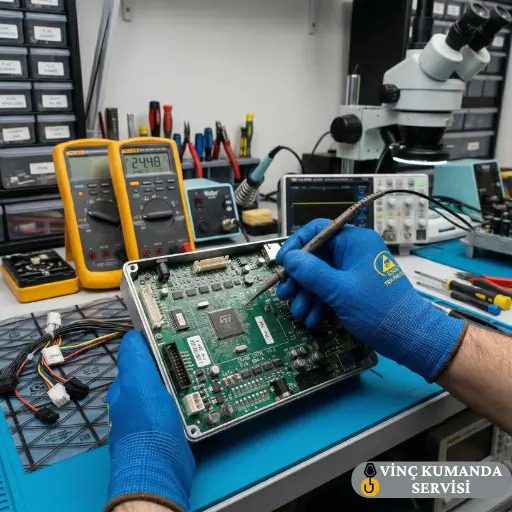
PCB damage, power circuit failure, and liquid ingress corrosion are major fault categories. These require component-level repair with specialist instrumentation — oscilloscope diagnosis, microscope-level soldering, and post-repair functional testing under load. Both labour and parts costs are substantially higher. As a result, major fault repairs produce the largest variation in quotes between service providers — because the diagnostic and repair depth varies significantly between engineering-level service and component-swap workshops.
Factor 2: Brand, Model and Spare Parts Availability
The brand and model of the remote control directly shapes the repair cost through its impact on spare parts availability and sourcing time. However, the relationship is not simply “domestic is cheaper than imported” — it is about how quickly the correct part can be obtained for the specific model.
Domestic vs Imported Brands
Domestic-manufacture brands — such as Elfatek — typically have higher spare parts availability and shorter sourcing timelines. Consequently, the total repair cost is lower because there is no import or air freight component in the parts cost, and no extended waiting period that prolongs the crane downtime. Imported European or Far Eastern brands may have some components that are not held in local stock — which adds both sourcing cost and lead time to the repair, and therefore to the total operational cost including crane downtime.
Discontinued Model Considerations
For models that are no longer in active production, sourcing original spare parts becomes increasingly difficult over time. Furthermore, when a part is genuinely unavailable, experienced service centres can often use a technically equivalent substitute component — but this option affects both the repair cost and, in some cases, the certification status of the repaired unit. If your remote control is an older discontinued model, ask the service team specifically about original parts availability before authorising the repair.
Factor 3: Original vs Aftermarket Spare Parts
The choice between original and aftermarket spare parts is one of the most consequential decisions in the repair process — and one that is often made by the service centre without the customer’s explicit awareness. However, it directly determines both the immediate repair cost and the long-term cost profile of the repaired unit.
Original Parts
Original manufacturer components have passed the same durability and environmental testing as the original unit — specifically including the IEC 60068 environmental testing standard that industrial crane remote control components must meet. The initial cost is typically 15–25% higher than equivalent aftermarket parts. However, original components consistently deliver 3–5 years of reliable service life in the same environment that the original unit was designed for.
Aftermarket Parts
Aftermarket components appear more economical at the point of repair. However, in industrial environments with dust, moisture, temperature cycling, and vibration — which are the conditions that cause crane remote control failures in the first place — aftermarket components degrade faster than original specification parts. Consequently, the same fault point may fail again within months of the repair, producing a second repair cost that eliminates the original saving. Always ask the service centre which specification of parts will be used, and confirm whether the repair warranty covers aftermarket components.
Factor 4: Service Centre Quality and Labour Cost
Labour cost is directly related to the technical level of the service centre. However, higher price does not always mean better service — and lower price does not necessarily mean poor service. What matters is the diagnostic approach the service centre uses, because this determines both the accuracy of the repair and the likelihood of recurrence.
Engineering-Level Service
Engineering-supervised service centres perform component-level fault diagnosis using oscilloscopes, microscopes, and thermal cameras before any component is replaced. This approach identifies the actual root cause — rather than replacing components until the symptom disappears. Consequently, engineering-level repair is more reliable and less likely to produce repeat faults than a component-swap approach. The labour cost is higher, but the total cost including the reduced probability of re-repair is consistently lower over the unit’s operational life.
Independent Technical Services
Independent services can offer competitive cost. However, before commissioning any repair, verify the service centre’s reference list, warranty policy, and spare parts sourcing. Specifically: does the service centre use original or aftermarket parts? Does the repair warranty cover parts or labour or both? What is the return procedure if the same fault recurs within the warranty period? For environments where the crane remote must meet IP or CE compliance — which includes most industrial settings — a service centre with engineering competency is not optional. For our full repair service offering, see our crane remote control repair and technical service page.
Factor 5: Turnaround Time and Expedited Service
Turnaround time affects both the operational downtime cost and the service price. Standard and expedited service represent genuinely different cost profiles — and the correct choice depends on the financial impact of production downtime during the repair period.
Standard Repair Turnaround
Standard repair turnaround is 2–7 business days, covering fault diagnosis, parts sourcing, repair, and post-repair testing. However, for imported brands where specific components are not held in local stock, the parts sourcing phase can extend this timeline — which extends crane downtime proportionally. When evaluating standard service, confirm specifically whether the required parts are in stock before accepting a turnaround commitment.
Expedited Service
24–48 hour expedited service carries a 20–50% premium over the standard service rate. However, for production-critical cranes where downtime has a measurable hourly cost, this premium is typically recovered within the first few hours of restored crane operation. Consequently, the correct approach is to calculate the production downtime cost per day and compare it to the expedited service premium — in most industrial production environments, expedited service is the economically rational choice when the crane is actively scheduled for production.
Factor 6: Repair vs Replacement — When Each Makes Financial Sense
For heavily used older remote controls, the repair cost sometimes approaches or exceeds the replacement cost — at which point the replacement option deserves serious evaluation. However, the crossover point is not just the repair-to-replacement price ratio; it also depends on parts availability, the unit’s remaining service life, and the cost of downtime while the repair or procurement is completed. Before purchasing a replacement, see our crane remote control selection criteria guide.
When Repair Is the Better Choice
- The fault is localised to a specific component or circuit area — not widespread across the PCB.
- The unit is under 5 years old and has operated within its rated environmental specification.
- Repair cost is below 50–60% of equivalent new unit cost — professional repair can restore equivalent performance at 30–40% of replacement cost in this scenario.
- Original parts for the specific fault are available in local stock — avoiding extended sourcing delays.
When Replacement Is the Better Choice
- Multiple independent fault areas exist across the unit — indicating general end-of-life deterioration rather than a specific repairable event.
- The model is discontinued and original spare parts are unavailable — making any repair dependent on substitute components with uncertain service life.
- Repair cost exceeds 60% of a new equivalent unit — at this level, the financial case for repair is weak even without considering the replacement unit’s warranty coverage and full expected service life.
Factor 7: Guaranteed Repair — Long-Term Calculation, Not Short-Term Cost
Guaranteed repair appears approximately 10% more expensive at the point of service than non-warranted repair. However, this premium provides protection against repeat fault cost — which is the actual risk being managed. Consequently, the 10% warranty premium is not an additional cost; it is an insurance premium against the most common post-repair failure scenario: the same fault point failing again within months of the repair.
What a Repair Warranty Must Cover
- Both parts and labour: A warranty that covers only parts but not labour, or only labour but not parts, provides limited protection. The repeat fault cost includes both components — if the service centre will not warrant both, the warranty has limited practical value.
- The specific repaired fault point: The warranty must cover recurrence of the same fault at the same location within the warranty period. A general “equipment warranty” that excludes the repaired component or circuit area is not a repair warranty.
- A defined warranty period: Minimum 3 months for aftermarket parts, minimum 6 months for original parts is the industry norm for industrial crane remote control repair. Request this in writing before authorising the repair.
Conclusion: Choose the Right Service, Not the Cheapest Quote
The seven factors that determine crane remote control repair cost — fault scope, brand and parts availability, original vs aftermarket components, service quality, turnaround time, the repair vs replacement decision, and warranty coverage — interact with each other in ways that make headline price comparison unreliable. A quote that appears cheapest on the day of service may produce the highest total cost over 12 months when repeat fault probability, downtime exposure, and parts service life are factored in. Consequently, the evaluation criterion for repair service selection should be transparent fault diagnosis, specified parts type, and documented warranty terms — not the lowest headline repair price. Vinç Kumanda Servisi provides free fault assessment and guaranteed repair for all brands we service.
Frequently Asked Questions
How much does crane remote control repair cost?
Repair cost varies significantly by fault type: minor faults such as button or battery replacement are low-cost, same-day repairs. PCB-level or power circuit repairs are substantially more expensive. The most accurate way to obtain a meaningful cost estimate is to commission a free fault assessment before authorising any repair — a quote without a prior diagnosis is not a reliable cost basis for a procurement decision.
Can any brand of crane remote control be repaired?
Most brands can be repaired — the variable is parts availability rather than repairability. Brands with active local distributor networks have higher original parts availability, which reduces both cost and turnaround time. For brands with limited local parts support, experienced service centres can use technically equivalent substitute components — but this should be disclosed in advance and reflected in the warranty terms offered for the repair.
What is the difference between original and aftermarket spare parts for crane remote repair?
Original parts have passed the same IEC 60068 environmental durability testing as the original unit — and consequently perform reliably in the same industrial conditions that caused the original failure. Aftermarket parts are typically 15–25% cheaper at the point of repair but carry a higher risk of early re-failure in demanding environments. For safety-critical crane remote control components — specifically emergency stop relay circuits — original parts are not optional; the safety assessment is only valid for original-specification components.
Is it better to repair or replace my crane remote control?
Repair is better when the fault is localised, the unit is under 5 years old, and repair cost is below 50–60% of equivalent new unit cost. Replacement is better when multiple independent fault areas exist, the model is discontinued with unavailable original parts, or repair cost exceeds 60% of new unit cost. An authorised service assessment will identify which applies — and a reputable service team will recommend replacement when it is genuinely the better value, not only when repair is possible.
How quickly can crane remote control repair be completed?
Standard repair turnaround is 2–7 business days, covering diagnosis, parts sourcing, repair, and post-repair testing. Expedited 24–48 hour service is available with a 20–50% premium over the standard rate. For production-critical cranes, the production downtime cost per day typically makes the expedited service premium the economically rational choice. Confirm parts stock availability before accepting a turnaround commitment — lead time for out-of-stock parts on imported brands can extend the timeline significantly.
What should a crane remote control repair warranty cover?
A valid repair warranty must cover both parts and labour for recurrence of the same fault at the same repair point, for a defined minimum period — at least 3 months for aftermarket parts and at least 6 months for original parts. Request this in writing before authorising the repair. A warranty that excludes either the repaired component or the labour to fix it provides limited practical protection and is not equivalent to a full repair guarantee.
Why does a non-warranted repair sometimes cost more in total than a warranted one?
A non-warranted repair that fails again within 6 months produces a second repair cost — plus the crane downtime cost for both incidents. When these are combined, the total frequently exceeds the cost of a single warranted repair that would have covered the recurrence without additional charge. The 10% warranty premium is consistently recovered the first time the warranty is invoked rather than a second repair invoice being raised.
Contact Vinç Kumanda Servisi
Need a free fault assessment for your crane remote control, or looking to understand the repair vs replacement decision for a specific unit? Contact Vinç Kumanda Servisi via WhatsApp at +90 532 546 84 62, email us at info@vinckumandaservisi.com, or visit our contact page. We provide free fault assessment and guaranteed repair for all brands we service — you can send your remote from anywhere.