Crane Remote Control Heartbeat Signal and Emergency Stop: Technical and Safety Requirements
Two safety functions define whether a crane remote control system is genuinely safe or simply functional under normal conditions: continuous heartbeat communication between transmitter and receiver, and a certified emergency stop circuit. Both are required by international safety standards — but not all products on the market meet these requirements to the same level, and the difference is not always visible from the product description alone. This guide explains what each function requires technically, what the standards mandate, and what to verify before purchasing a crane remote control system for industrial use.
Get in Touch for All Your Requirements
Continuous Heartbeat Communication: Technical Requirements
The heartbeat signal is a continuous, bidirectional communication handshake between the crane remote control transmitter and the receiver unit. It operates independently of operator button inputs — the system is constantly confirming that the communication link is intact. When the heartbeat is interrupted for any reason, the system immediately recognises that the link has failed and responds accordingly.
RF Stability and Interference Resistance
Crane remote controls from certified manufacturers are designed to maintain the heartbeat signal through electromagnetic interference typical of industrial environments — motor drives, welding equipment, large transformers, and rectifier systems all generate RF noise that can disrupt poorly designed systems. FHSS (Frequency Hopping Spread Spectrum) technology strengthens heartbeat reliability by continuously shifting the operating frequency, making the signal resistant to fixed-frequency interference sources. Systems without FHSS on a fixed frequency channel are more vulnerable to signal disruption in EMI-dense environments.
Fail-Safe Response on Signal Loss
When the heartbeat signal is lost — whether from interference, the operator moving out of range, battery failure, or physical obstruction — a certified system must enter Emergency Stop mode automatically and immediately. This fail-safe response is what separates a certified crane remote control from a system that simply stops receiving commands. The distinction matters critically: a system that stops receiving commands may continue executing the last received instruction. A fail-safe system arrests all crane motion the moment link integrity is lost.
Command Latency
The time between an operator pressing a button and the crane responding to that command must be consistent and minimal. In precision load positioning — setting down heavy components onto fixtures, threading loads through tight clearances — command latency of even a few hundred milliseconds creates positioning errors. Certified industrial crane remote controls specify maximum latency values in their technical documentation. Systems without documented latency specifications should be evaluated carefully for precision applications.
Emergency Stop Button: Technical and Safety Requirements
The emergency stop button is the most safety-critical component of any crane remote control system. Its function is absolute: when pressed, all crane motion must arrest immediately, under all conditions, regardless of the state of any other system component. This requirement is straightforward to state — but not straightforward to engineer, and not all products on the market achieve it.
Response Time and Circuit Architecture
A compliant emergency stop circuit must respond within a defined maximum time from button press to crane arrest — typically under 200 milliseconds for the complete chain from transmitter signal to receiver relay opening. This requires high-precision electronic circuit design. Systems with software-only emergency stop implementation — where the stop command is processed through the main controller — are inherently slower and less reliable than hardware-level relay circuits that operate independently of the control software.
Redundant Relay Architecture
A PL-d / SIL 2 compliant emergency stop uses two independent safety relays in the receiver unit, with microprocessor cross-monitoring of both relay states. If one relay fails — stuck closed, open-circuit, or contact weld — the second relay still arrests the crane, and the fault is detected to prevent the next operational cycle. A single-relay emergency stop circuit cannot meet PL-d requirements regardless of its response speed, because a single component failure disables the entire safety function.
Physical Design Standards
ISO 13850 and EN 60204-1 define the physical design requirements for emergency stop actuators: red mushroom-head button on a yellow background, located in a position accessible to the operator without repositioning the hand, and protected against accidental activation while remaining immediately operable in an emergency. These are not aesthetic requirements — they are ergonomic safety requirements that ensure the button can be activated quickly and reliably under stress conditions.
Applicable Safety Standards
The following standards directly define the requirements for heartbeat communication and emergency stop in crane remote control systems. Compliance with these standards is not self-declared through CE marking alone — it requires documented safety assessment.
- ISO 13849-1 (PL-d): Defines the Performance Level requirements for safety-related control systems. PL-d is the minimum required level for crane emergency stop and fail-safe signal loss response. Requires Category 3 hardware architecture with high MTTFd and medium-to-high diagnostic coverage — achievable only through redundant relay design with cross-monitoring.
- IEC 62061 (SIL 2): The equivalent standard for electronic and programmable safety systems, expressed as a mathematical probability of dangerous failure per hour. SIL 2 corresponds to a PFHd between 10⁻⁷ and 10⁻⁶ — the same safety level as PL-d expressed through a different methodology.
- ISO 13850: Specifically governs the design of emergency stop functions — response time, actuator physical design, and reset requirements. Applies directly to the E-STOP button on crane remote controls.
- EN 60204-1: Electrical safety of machinery — covers the complete electrical design requirements including emergency stop circuit architecture, wiring standards, and protection against mal-operation.
- EU Machinery Directive 2006/42/EC: Requires that machinery with hazardous motion incorporates an emergency stop function, and that control devices cannot cause unintended activation. The 2025 supplementary regulations specifically address wireless remote control fail-safe requirements.
What to Verify Before Purchasing a Crane Remote Control
The checklist below addresses the specific heartbeat and emergency stop requirements that must be verified — not assumed — before committing to a crane remote control system. Products that cannot provide documentation for each item should be treated as non-compliant for industrial crane applications.
- Heartbeat monitoring confirmed: Does the system continuously monitor transmitter-receiver communication independent of button inputs — with a documented detection response time?
- Fail-safe signal loss response: Does signal loss trigger automatic Emergency Stop mode, or does the crane simply stop receiving new commands while potentially continuing the last instruction?
- Redundant emergency stop relays: Does the receiver unit contain two independent safety relays with microprocessor cross-monitoring — not a single relay or software-only implementation?
- ISO 13849-1 (PL-d) or IEC 62061 (SIL 2) documentation: Can the supplier provide the safety assessment report — not just CE Declaration of Conformity?
- ISO 13850 E-STOP physical design compliance: Red mushroom head on yellow background, ergonomically positioned, protected against accidental activation?
- Documented command latency: Is maximum transmitter-to-crane response time specified in the technical datasheet?
- Spare parts and service availability: Are replacement safety relays and receiver boards stocked locally — and what is the lead time?
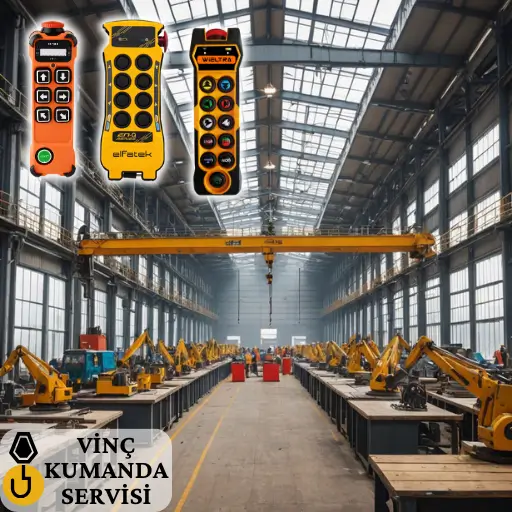
All brands supplied by Vinç Kumanda Servisi — Elfatek, Wieltra, Aykos, Mikotek, Henjel, Remobat, and Telemmote — meet PL-d / SIL 2 requirements and can provide full certification documentation. For the complete product range see industrial crane remote controls, or for technical service and repair support see our crane remote control repair and technical service page.
Conclusion
Continuous heartbeat communication and a certified emergency stop circuit are not optional features in crane remote control systems — they are the engineering foundation that determines whether the system is safe or simply operational. The difference between a system with and without these functions is not apparent during normal operation; it only becomes apparent when something goes wrong. Specifying and verifying these functions before purchase — through documentation, not product descriptions — is the only reliable way to confirm that the safety architecture is in place. Products that cannot provide ISO 13849-1 or IEC 62061 certification alongside CE marking have not demonstrated the safety level required for industrial crane applications.
Frequently Asked Questions
What is the heartbeat signal in a crane remote control?
The heartbeat signal is a continuous communication handshake between transmitter and receiver that operates independently of operator button inputs. It confirms in real time that the communication link is intact. When the heartbeat is interrupted — for any reason — the system detects the loss and triggers the appropriate fail-safe response. It is the mechanism that allows the crane to distinguish between “operator has not pressed a button” and “the communication link has failed.”
What should happen when a crane remote control loses signal?
On a PL-d / SIL 2 certified system, signal loss triggers an automatic Emergency Stop — all crane motion arrests immediately. On non-certified systems, the crane may simply stop receiving new commands while continuing to execute the last instruction. This distinction is critical: in a travel or hoist motion scenario, a non-fail-safe system continues moving with no operator input until it hits a limit switch or obstruction. A fail-safe system stops the moment the link is lost.
What is the difference between a CE-certified and a PL-d certified emergency stop?
CE marking is a self-declaration of compliance with applicable EU directives — it covers radio equipment and EMC requirements. PL-d certification under ISO 13849-1 specifically addresses the safety function architecture of the emergency stop circuit — redundant relays, cross-monitoring, MTTFd, and diagnostic coverage. A product can carry CE marking without achieving PL-d. Always request the ISO 13849-1 safety assessment document separately when evaluating emergency stop compliance.
Why do emergency stop buttons need to be red on a yellow background?
ISO 13850 specifies the red-on-yellow actuator design for emergency stop functions to ensure immediate visual identification under stress conditions. The colour coding is a standardised human factors requirement — operators must be able to locate and activate the emergency stop instantly without visual search. Products that use different colours, smaller actuators, or non-mushroom-head designs do not meet ISO 13850 ergonomic requirements and may fail safety inspections on physical design alone.
How quickly must a crane emergency stop respond?
The complete emergency stop chain — from button press at the transmitter to relay opening at the receiver — should complete within 200 milliseconds for most industrial crane applications. Hardware-level relay circuits achieve this consistently; software-only implementations are inherently slower and subject to processing delays. The response time should be documented in the product’s technical datasheet — if it is not specified, treat the system as non-compliant for time-critical stopping applications.
What is cross-monitoring in a redundant relay emergency stop?
Cross-monitoring is a microprocessor function that continuously checks the state of both safety relays in the receiver unit. If one relay fails — contact weld, open circuit, or stuck closed — the cross-monitoring system detects the discrepancy between the expected and actual relay states. It then prevents the system from entering the next operational cycle until the fault is cleared. This is what makes the redundant relay architecture an active safety function rather than a passive backup.
Does every crane remote control have a heartbeat signal?
No. Basic or budget-tier crane remote controls may not implement continuous heartbeat monitoring. These systems respond to button inputs but do not maintain a continuous link verification — meaning signal loss is only detected when the operator attempts to send a command and receives no response. This is fundamentally different from a system that detects link loss in real time and responds with an automatic fail-safe stop. Always verify heartbeat implementation explicitly when evaluating any crane remote control system.
What standards govern the emergency stop in crane remote controls?
The primary standards are: ISO 13849-1 (PL-d) for hardware safety architecture; IEC 62061 (SIL 2) for electronic safety integrity; ISO 13850 for emergency stop physical design and ergonomics; EN 60204-1 for electrical equipment design of machinery; and the EU Machinery Directive 2006/42/EC for market access compliance. All five are relevant — they address different aspects of the same safety function and must all be satisfied simultaneously.
Can command latency affect safety in crane remote controls?
Yes — particularly in precision load placement applications. Inconsistent or excessive command latency means the crane responds at a slightly different time than the operator expects. In normal transport operations this is minor. In precision positioning — placing a heavy component onto a fixture with tight tolerances — unpredictable latency causes overshoot and requires multiple correction moves. High-quality industrial crane remote controls specify maximum latency and maintain it consistently; budget systems often exhibit variable latency that worsens under interference conditions.
Is continuous heartbeat communication required by law?
The EU Machinery Directive 2006/42/EC and the Work Equipment Directive 2009/104/EC both require that crane control systems respond safely to any failure condition — including communication loss. Continuous heartbeat monitoring with automatic fail-safe response is the engineering implementation of this requirement. While the regulations do not use the term “heartbeat signal”, the safety outcome they mandate — safe crane arrest on any communication failure — can only be reliably achieved through continuous link monitoring. A system without heartbeat monitoring cannot guarantee this outcome.
Contact Vinç Kumanda Servisi
Need to verify whether your current crane remote control meets heartbeat and emergency stop requirements, or looking to specify a certified system for a new installation? Contact Vinç Kumanda Servisi via WhatsApp at +90 532 546 84 62, email us at info@vinckumandaservisi.com, or visit our contact page for a tailored quote.