Crane Remote Control Brands: 8 Differences That Matter When Specifications Look Identical
You are comparing two crane remote control models from different brands — the technical catalogues show nearly identical specifications, but the prices differ. This situation is extremely common in industrial procurement, and the instinct to select the lower-priced option is understandable. However, the criteria that determine actual field performance — material quality, service accessibility, safety certification, and total cost over three to five years — do not appear in a technical datasheet. This guide covers the eight criteria that reveal real differences between crane remote control brands when the published specifications look the same.
Get in Touch for All Your Requirements
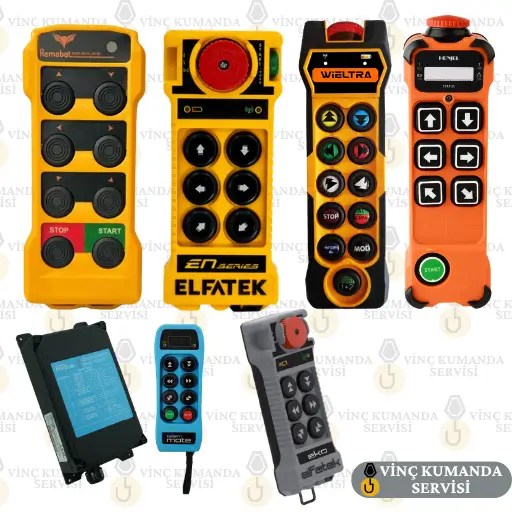
Eight Criteria at a Glance
The table below summarises all eight criteria, the key evaluation point for each, and the reference standard or indicator where applicable. Each criterion is covered in detail in the sections that follow.
| Criterion | Key Evaluation Point | Reference Standard / Indicator |
|---|---|---|
| 1. Material Quality | Housing material, button service life | IP65 or above, button cycle rating |
| 2. Ergonomics | Button layout, unit weight | Gloved-hand usability test |
| 3. Software and Technology | Firmware updates, interference rejection | IEC 62745, FHSS capability |
| 4. Service and Spare Parts | Response time, local parts stock | Number of local service points |
| 5. Total Cost of Ownership | Maintenance + parts + downtime | 3–5 year TCO projection |
| 6. Brand Reliability | Sector references, field history | Authorised distributor presence |
| 7. Certification | CE, IP class, environment compliance | CE, ATEX (where required), EN 60068 |
| 8. Battery Performance | Real operating duration, swap ease | Temperature range test documentation |
1. Material Quality
The most significant hidden differentiator between two crane remote controls with identical technical specifications is material quality. Housing impact resistance, PCB solder quality, and button mechanism service life determine how differently two units perform in the same industrial environment over time. Consequently, material quality differences that are invisible at the point of purchase become apparent within the first 12–18 months of field operation.
What to Evaluate
- Housing material: Industrial crane remote controls require minimum ABS with rubber hybrid overmoulding, or polycarbonate housing. IP65 or above protection class confirms the housing has been tested against dust and water spray ingress — not just rated for it on paper. Standard plastic housings without rubber overmoulding degrade under UV exposure and impact loads significantly faster than the rated IP class suggests.
- Button cycle rating: Button mechanisms are rated to a specific number of actuations by the manufacturer. Units rated for 500,000 cycles versus 100,000 cycles perform very differently in high-frequency operation — a crane remote button that is pressed hundreds of times per shift will reach 100,000 cycles in months, not years. Request the button cycle rating from the technical documentation before purchase.
2. Ergonomics and Ease of Use
Of two technically equivalent crane remote controls, one may fatigue the operator more quickly due to incorrect button placement or unbalanced weight distribution. Over an 8-hour shift, this difference directly affects both productivity and safety — specifically, operator fatigue increases command error rate, and command errors in crane operation have consequences that exceed the purely operational.
Ergonomic Differences to Evaluate
- Button layout and size: Critical commands — emergency stop and hoist up/down — should be positioned within natural thumb reach without hand repositioning. Well-designed remotes minimise command errors even when used with protective gloves. A layout that requires the operator to look at the remote to locate buttons during operation is a safety design deficiency.
- Unit weight: The difference between 600g and 900g becomes significant over an 8-hour shift — the heavier unit produces measurably greater shoulder and wrist fatigue. Request the unit weight from the technical data sheet and evaluate it in the context of shift duration and operation frequency.
- Carrying system quality: The neck strap or belt clip is almost universally overlooked during procurement. However, a strap or clip that fails in service — allowing the remote to drop — has immediate operational and safety consequences. Inspect the attachment hardware quality, not just the remote itself.
3. Software and Technology
Two crane remote controls operating on the same frequency band — 433 MHz or 868 MHz — can differ significantly in their data transmission protocol and frequency hopping algorithm. However, this difference is invisible in the catalogue and only becomes apparent in electromagnetically complex environments where interference from other wireless devices, welding equipment, or adjacent crane systems is present.
Technology Differences to Evaluate
- Firmware update availability: A remote control that can receive firmware updates allows security vulnerabilities to be closed and new features to be added over its operational life. Some brands provide updates free of charge; others charge for them or do not offer them at all. Confirm the firmware update policy before purchase — a system that cannot be updated is effectively frozen at its launch-day capability for its entire service life.
- IEC 62745 safety software: This standard defines the safety software requirements for wireless crane remote controls — specifically, controlled crane arrest in the event of operator error or signal loss. A system compliant with IEC 62745 will not simply drop the load if signal is interrupted; it will execute a controlled stop sequence. This is a genuine differentiator between otherwise equivalent systems and should be specifically confirmed rather than assumed.
4. Service Network and Spare Parts Availability
The long-term cost of a crane remote control purchase is largely determined by service accessibility. A remote control with unavailable spare parts or long service lead times causes production stoppages — and the hourly cost of an unplanned crane stoppage frequently exceeds the original purchase price of the remote within a single incident. Consequently, service network quality is not a secondary criterion; it is a primary cost driver.
Service Factors to Verify Before Purchase
- Local authorised service network: The number of authorised service points and average response time varies significantly between brands. For imported brands without a local service network, spare part lead times of 3–6 weeks are common — during which the crane remains out of service. Confirm local service capability specifically, not just distributor presence.
- Spare parts stock: Are transmitter and receiver PCBs, button assemblies, and battery packs held in local stock — or sourced to order? Ask this question directly before purchase. A distributor who cannot confirm local stock for these specific components cannot guarantee a short-lead-time repair when a fault occurs.
- Warranty scope and duration: The difference between 1-year and 3-year warranty is not only duration — the scope varies. Does the warranty include the battery pack? Does it cover mechanical damage? Are labour costs included? Read the warranty terms, not just the warranty period headline. For our repair and service offering, see our crane remote control repair and technical service page.
5. Price Differences and Total Cost of Ownership
Catalogue price should not be the sole decision criterion. Understanding the source of the price difference between two equivalent-specification systems determines the quality of the procurement decision — not the headline price comparison itself.
The TCO Calculation
- Initial purchase cost: A lower initial price reduces the first investment. However, a remote control produced with lower material specification can accumulate maintenance and repair costs within the first two years that exceed the total cost of the more expensive alternative — including its higher purchase price.
- 3–5 year TCO projection: When spare parts cost, periodic maintenance, potential production downtime, and service labour are included in the calculation, the lower-priced option frequently produces the higher total cost. A TCO projection covering 3–5 years is the correct basis for a procurement decision — not the purchase price alone. For a detailed cost framework, see our crane remote control repair cost guide.
6. Brand Reliability and Field References
Brands with long operational histories in the crane remote control sector have accumulated field data that newer market entrants do not have access to. Specifically, they know which failure modes appear in which environments — and they have incorporated this feedback into their design and manufacturing processes. A brand that has been operating in heavy industry for 15 years has solved problems that a brand entering the market this year will encounter for the first time in your facility.
Brand Reliability Indicators
- Sector references: In which sectors and at which facility scale does the brand have reference installations? A brand with heavy steel mill and port references has been tested in conditions that a brand with only light manufacturing references has not. Ask for reference contacts in your specific sector, not just a general reference list.
- Indirect reliability indicators: Presence at industry trade shows, an authorised distributor network with technical depth, and the quality of technical documentation all indicate the level of infrastructure investment behind the brand. A brand that cannot supply a complete technical manual for its receiver unit does not have the documentation infrastructure to support competent field service.
7. Certification and Safety Standards
CE marking is the mandatory minimum standard for European market access — however, it is not a safety guarantee in isolation. For industrial crane remote controls, the certifications that actually confirm field safety performance are EN ISO 13849-1 for safety function architecture, EN 60068 for environmental durability, and IEC 62745 for wireless crane remote safety software. In explosive atmosphere installations, ATEX certification is additionally mandatory — CE marking does not substitute for it.
Certification Evaluation Points
- CE and beyond: CE marking confirms EU regulatory compliance. Additionally, an IP65 or IP67 ingress protection certificate confirms the housing has been physically tested — not just rated — against dust and water. Request both the CE declaration and the IP test certificate separately.
- Local regulatory requirements: OHS regulations in many jurisdictions require periodic inspection of crane control systems. Confirm that the selected system’s certification documentation supports the periodic inspection requirements applicable to your facility — not just the initial installation compliance.
8. Energy Efficiency and Battery Performance
Battery capacity stated in the datasheet is not a reliable operating duration figure without context. Real operating time — under actual continuous use conditions rather than standby or intermittent-use test conditions — depends on transmitter-receiver communication frequency, standby power consumption, and ambient temperature. Consequently, a battery rated for 8 hours under test conditions may deliver 4–5 hours under continuous active operation.
Battery Performance Points to Verify
- Real operating duration at temperature: Under which specific conditions did the manufacturer test battery operating time? Is performance at +40°C or −10°C documented in the technical data? These figures should be in the technical documentation — not in the marketing materials. A system used in an outdoor winter environment without cold-temperature battery performance data is an unquantified operational risk.
- Charge connector standardisation: Is the charge cable a standard connector (USB-C, micro-USB) or a brand-proprietary connector? A proprietary charge cable that becomes unavailable creates an avoidable operational problem. Furthermore, can the battery be swapped by the operator in the field, or does battery change require authorised service? Systems allowing fast field battery swap minimise production downtime when a battery reaches end-of-shift capacity.
Conclusion: Same Specifications, Different Decision Criteria
When technical catalogues show identical numbers, the real differences between crane remote control brands appear in material quality, service accessibility, software architecture, and safety certification depth. The lower-priced option at initial purchase consistently produces the higher total cost over 3–5 years when these factors are included in the evaluation. Vinç Kumanda Servisi performs comparative technical analysis for the brands we supply — and presents both options with a cost comparison so the selection is made on verified criteria rather than catalogue comparison alone. Contact our technical team for a recommendation matched to your application and environment.
Frequently Asked Questions
Why is there a price difference between two crane remote controls with the same specifications?
The main sources of price difference are material specification, safety certification costs, warranty scope and duration, firmware development investment, and after-sales service infrastructure. A lower-priced model appears attractive at initial purchase — however, when total cost of ownership is calculated over 3–5 years, the picture consistently changes in favour of higher-specification products.
Is CE marking sufficient when selecting a crane remote control?
CE marking is the mandatory minimum for European market access — but it does not guarantee field adequacy on its own. For industrial environments, IP65 or above ingress protection, IEC 62745 safety software compliance, and EN 60068 environmental durability certification should all be evaluated alongside CE. For explosive atmosphere applications, ATEX certification is additionally mandatory — CE does not substitute for it.
Can crane remote controls from different brands work together?
As a general rule, no. Transmitter and receiver units from different brands are specific to their own communication ecosystem — the pairing protocol, safety relay architecture, and watchdog implementation are brand-specific. Some brands offer universal receiver solutions as an exception, but this is not the standard. Furthermore, mixing components from different brands voids the warranty of both products and removes CE certification validity from the combined system.
How should I evaluate the service network when buying a crane remote control?
Ask four specific questions before purchase: Is there an authorised technical service point locally? Are spare parts — specifically receiver PCBs and button assemblies — held in local stock or sourced to order? What is the average fault response time when a crane is out of service? Is maintenance service included in the warranty scope? A distributor who cannot provide specific answers to all four questions does not have the service infrastructure to support production-critical crane remote control equipment.
What does IEC 62745 compliance mean for a crane remote control?
IEC 62745 defines the safety software requirements for wireless crane remote control systems — specifically covering controlled crane arrest in the event of signal loss, operator error, or system fault. A system compliant with this standard will not drop a suspended load if the transmitter signal is interrupted; it will execute a controlled stop sequence. This is a genuine functional differentiator between otherwise equivalent systems and should be confirmed from the technical documentation rather than assumed from the general product description.
How does button cycle rating affect the real service life of a crane remote control?
Button cycle rating defines the number of actuations the button mechanism is tested to before failure probability increases. A crane remote in continuous operation may accumulate hundreds of button presses per shift — meaning a unit rated for 100,000 cycles could reach its rated limit in under a year of intensive use, while a unit rated for 500,000 cycles will last significantly longer under the same conditions. Request the cycle rating from the technical documentation and calculate expected lifetime based on your actual operation frequency.
What is the risk of using a crane remote control without FHSS technology on a multi-crane site?
Without FHSS and software-based channel locking, two crane remote controls operating on the same frequency band — even if assigned different fixed channels — can experience channel collision when wireless traffic on the site is high. In the worst case, this produces cross-activation: one crane’s remote triggering motion on a neighbouring crane. This is both an operational disruption and a safety incident. For any site with more than one active wireless crane remote, FHSS and encrypted channel locking are mandatory specifications, not optional upgrades.
Contact Vinç Kumanda Servisi
Comparing crane remote control brands for a specific application and need a technical analysis rather than a catalogue comparison? Contact Vinç Kumanda Servisi via WhatsApp at +90 532 546 84 62, email us at info@vinckumandaservisi.com, or visit our contact page for a tailored recommendation.