Crane Remote Control Repair: Should You Do It Yourself or Call Professional Service?
The short answer: no — crane remote control repair requires electronic circuit knowledge, RF frequency testing, and crane safety expertise that are not accessible through general maintenance experience. An incorrect intervention can permanently damage functional circuits, void the product warranty, and — most seriously — disable safety functions on a system that controls loads of 5 to 50 tonnes. This guide explains what is actually at risk in DIY repair, compares the real total costs, and covers what to look for when selecting a professional service.
Get in Touch for All Your Requirements
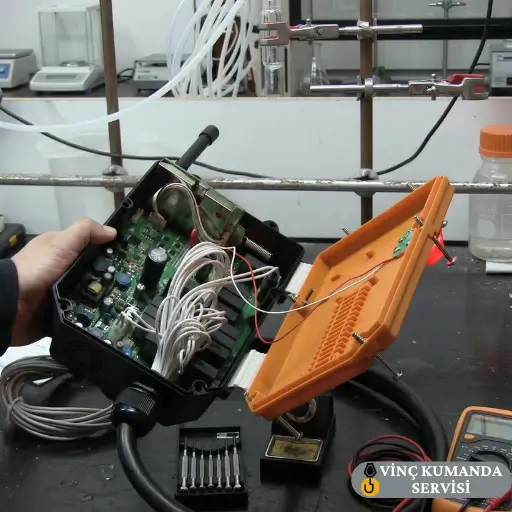
Why Crane Remote Control Faults Are More Complex Than They Appear
Crane remote controls are multi-layer systems — RF transmitter-receiver circuits, relay output boards, voltage regulators, and firmware-based control algorithms all interact. Consequently, the fault source frequently does not correspond to the visible symptom. A remote that is completely unresponsive may have a microscopic PCB crack in the receiver unit rather than a flat battery — and treating the symptom without identifying the actual cause either fails to resolve the fault or causes additional damage to circuits that were previously functioning.
Why Correct Diagnosis Requires Specialist Equipment
Accurate diagnosis of crane remote control faults requires instruments that are not available in a field maintenance kit — specifically an oscilloscope for signal waveform analysis, a frequency analyser for RF circuit verification, and in some cases brand-specific diagnostic software for firmware and configuration state inspection. Without these instruments, a technician is working from symptom observation alone — which is insufficient to distinguish between, for example, a receiver PCB fault, a frequency calibration drift, and an interference-induced pairing corruption that all produce identical external symptoms.
What Safety Risks Does Incorrect Repair Create?
A crane remote control directly commands a system handling 5 to 50 tonnes of suspended load. Consequently, an incorrect repair intervention can produce safety failures that are not apparent during a bench test but emerge under operational load conditions. The three specific safety risks are:
- Emergency stop circuit disablement: The E-stop circuit is the safety layer that operates independently of the main control software. An incorrect connection during repair — specifically reconnecting the NC contact wiring incorrectly after opening the unit — can render the emergency stop non-functional while allowing all other crane functions to operate normally. The system passes a basic function test but the safety layer has been disabled. This is the most dangerous possible repair outcome.
- Uncontrolled load release: A receiver relay incorrectly reassembled after disassembly may have reduced contact force — passing a no-load test but failing to maintain contact under the current drawn by a crane motor contactor at rated load. The result is an uncontrolled release of the contactor during crane motion, which produces uncontrolled load movement.
- Operator exposure without awareness: A crane remote that appears to function normally but has a delayed or intermittent command response causes the operator to compensate by positioning closer to the load — eliminating the safety margin that wireless control is specifically designed to maintain.
CE Certification and Legal Liability
For CE-certified crane remote control systems, unauthorised repair resets the product’s compliance status. Specifically, the CE Declaration of Conformity is issued by the manufacturer for the product as manufactured — any modification or repair that is not performed by the manufacturer or authorised service voids this declaration. As a result, if a workplace incident occurs following unauthorised repair and an OHS inspection requests the certification documentation, the lack of valid CE coverage places full legal liability on the facility operator. Furthermore, the insurer may decline the claim on the same basis.
Is DIY Repair Actually Cheaper? The Real Cost Comparison
DIY repair appears cheaper at first glance — no labour charge, just parts. However, the actual total cost comparison tells a different story in most cases.
The Hidden Cost Components of DIY Repair
- Wrong part procurement: Without accurate diagnosis, the first part ordered is frequently not the correct one — resulting in procurement cost, return shipping, and the additional delay before the correct part is identified and ordered.
- Additional damage during disassembly: Opening a crane remote control housing without the correct tools and procedures risks damaging the PCB surface, breaking antenna connections, and disturbing previously functional relay contacts. In practice, each disassembly attempt that does not resolve the fault increases the probability of additional damage that escalates the final repair cost.
- Extended production downtime: The time from fault discovery to working crane is significantly longer when DIY repair is attempted. Professional service resolves most faults within 1–2 business days. DIY attempts — including wrong part ordering, repeated disassembly, and eventual escalation to professional service — typically extend the total downtime to 3–5 days in our field experience.
When wrong part procurement cost, additional damage repair cost, and extended production downtime are combined, the total DIY cost typically runs 40–60% higher than professional repair from the outset — and that calculation does not include the scenario of irreversible PCB damage requiring complete unit replacement. For a detailed breakdown of professional repair cost factors, see our crane remote control repair cost guide.
How Unauthorised Repair Affects the Product Warranty
Opening a crane remote control under manufacturer warranty without authorisation typically terminates the warranty immediately and permanently. Furthermore, this is not a contractual technicality — it reflects the genuine fact that the manufacturer cannot verify the condition of the product after unauthorised disassembly. Consequently, any subsequent fault — whether related to the original repair or not — becomes a full-cost repair rather than a warranty claim.
The Spare Parts Access Risk
Some manufacturers, when evidence of unauthorised repair is detected, also decline to supply original spare parts for that unit — treating the serial number as ineligible for authorised service support. As a result, a unit that had unauthorised repair may be permanently cut off from original component supply, forcing future repairs to use aftermarket parts regardless of their suitability.
Professional service after repair provides its own separate warranty — typically 3–6 months covering both parts and labour for the repaired fault point. Consequently, the repaired unit carries documented warranty coverage that self-repair cannot provide. This post-repair warranty is the correct mechanism for managing the recurrence risk that the original manufacturer warranty no longer covers after the failure event.
Wrong Parts: What Happens When a “Similar” Component Is Installed
Electronic components in crane remote controls — receiver modules, relay boards, encoder circuits — are brand and model specific. A component that appears physically identical and carries the same nominal specification may have different voltage tolerances, timing characteristics, or frequency response profiles that cause instability or damage to adjacent circuits. Furthermore, in crane remote control systems specifically, a receiver relay with a slightly different contact gap or contact material specification can pass a no-load functional test while failing to interrupt the contactor coil current reliably under rated load.
Why Professional Services Use Original Parts
Authorised service centres hold manufacturer-approved original spare parts stock. Original components restore the unit to factory specification — not just functional appearance. Specifically, this means the safety relay architecture returns to the certified PL-d performance level that the safety assessment was based on — which is not achievable with substitute components that have not been included in that assessment. For the complete repair and technical service offering, see our crane remote control repair and technical service page.
What to Look For When Selecting a Professional Service
Not all repair services are equivalent. The following criteria distinguish engineering-level service from basic component-swap workshops — and the difference directly affects both repair reliability and the safety status of the repaired unit.
- Brand expertise: The service must have specific experience with the brand and model being repaired. General electronics repair services may not have access to brand-specific firmware tools, calibration parameters, or pairing procedures — which are essential for correct post-repair function verification.
- Original parts confirmation: Ask directly whether the repair will use original manufacturer-approved components or aftermarket substitutes. This question should be answered immediately and specifically — a service that cannot confirm parts provenance does not have the supply chain to back a meaningful warranty.
- Post-repair warranty period: Reputable services provide a minimum 3–6 month warranty covering the specific repaired fault point, with both parts and labour included. Request this in writing before authorising the repair.
- On-site service capability: Some crane remote control faults cannot be reproduced or verified without the crane operating under load — specifically, receiver relay contact faults and fail-safe response time issues. A service that can send a technician to site provides a significant advantage for these fault types over workshop-only service.
Conclusion
DIY crane remote control repair appears to save money in the short term — but the actual total cost, when wrong part procurement, additional damage, extended downtime, warranty loss, and safety risk are included, consistently exceeds professional repair cost. Furthermore, the safety consequences of an incorrectly repaired emergency stop circuit or safety relay are not recoverable by cost — they are operational and legal liabilities that professional repair specifically prevents. If you notice a fault developing, addressing it early with professional service produces both the lowest total cost and the lowest safety exposure. Contact us to start the process remotely — a phone description of the symptoms often allows us to estimate the fault category before you bring the unit in.
Frequently Asked Questions
How long does crane remote control professional repair take?
Most faults are resolved within 1–2 business days — including diagnosis and parts installation. PCB-level damage or faults requiring specific part sourcing extend this to 3–5 business days. Expedited 24-hour service is available for production-critical situations with a corresponding service premium. Providing the brand name, model number, and symptom description when contacting the service team shortens the diagnosis phase and consequently the total turnaround time.
Why should I not repair a crane remote control myself?
Three specific reasons: first, insufficient diagnosis without specialist instruments produces incorrect part selection and additional circuit damage. Second, incorrect reassembly of safety circuits — specifically the E-stop NC contact wiring — can disable the emergency stop function while allowing all other functions to work normally. Third, unauthorised repair voids the manufacturer warranty immediately and may disqualify the unit from future original spare part support. None of these risks exist when professional authorised service is used.
Is repair or purchasing a new crane remote control more cost-effective?
When the fault is localised to a specific component or board area, professional repair typically costs 20–40% of new unit price — making repair significantly more cost-effective. However, when multiple independent fault areas exist, or when the model is discontinued and original parts are unavailable, replacement becomes the better value. The service team presents both options with a cost comparison after diagnosis — so the decision is made on verified fault information rather than assumption.
Is on-site repair service available?
Yes. For faults in the receiver unit that cannot be separated from the crane system — or for situations where the full system test under load is required to verify the repair — our service team can attend on site. On-site service is particularly relevant for receiver relay contact faults and fail-safe response time verification, which cannot be reliably confirmed without the crane operating under rated load conditions.
Is a warranty provided after professional crane remote repair?
Yes. All repairs include warranty coverage for both the work performed and the parts installed. If the same fault recurs at the same repair point within the warranty period, it is re-serviced at no additional charge. This warranty is the document that distinguishes professional repair from DIY repair from a risk management perspective — it is the one protection against repeat fault cost that self-repair cannot provide.
What happens if a “similar” part is used instead of the original in a repair?
A substitute part may pass a no-load bench test while failing under rated load conditions — specifically because relay contact characteristics that are within tolerance for the substitute component may be out of specification for the contactor coil current of the specific crane motor. Furthermore, substitute components used in the safety relay circuit invalidate the PL-d safety assessment — the safety architecture is only certified for original-specification components. A functional-looking repair with substitute safety relay components is not a safe repair.
How do I know if a repair service is using original parts?
Ask directly — before authorising the repair — whether the service uses original manufacturer-approved components or aftermarket substitutes. A service with genuine original parts supply will confirm this immediately and specifically. If the answer is vague or hedged, treat it as aftermarket. Additionally, request that the repair invoice specifies the parts used and their origin — this documentation is important both for the warranty claim process and for future CE compliance verification.
Contact Vinç Kumanda Servisi
Have a crane remote control fault and not sure whether to attempt repair yourself or call professional service? Contact Vinç Kumanda Servisi via WhatsApp at +90 532 546 84 62, email us at info@vinckumandaservisi.com, or visit our contact page — we can assess the fault remotely based on symptom description before you send the unit in.