Crane Remote Control Selection: 7 Technical Criteria You Must Check Before Buying
Selecting the right crane remote control requires evaluating seven technical criteria: IP protection rating, frequency management, ergonomics, safety certification, battery performance, service network, and total cost of ownership. Overlooking any one of them creates either a production stoppage or a safety risk — sometimes both. The market offers dozens of brands and models, and price-focused selection consistently produces poor outcomes. A standard plastic-housing, unbranded remote control can be out of service within months in a dusty or chemically aggressive environment. This guide walks through all seven criteria with the technical detail and field context needed to make a well-founded purchasing decision.
Get in Touch for All Your Requirements
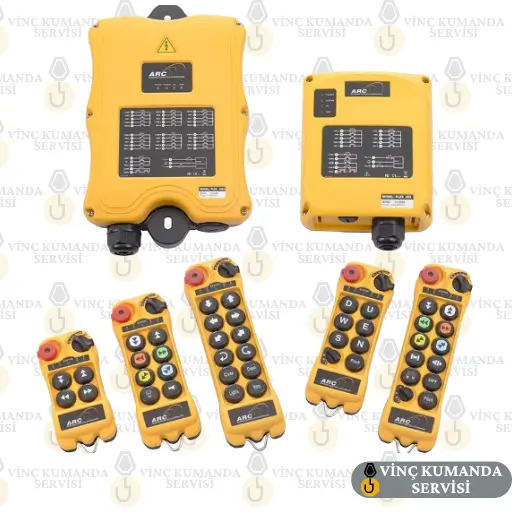
Criterion 1: Operating Environment and IP Protection Class
The IP (Ingress Protection) rating is the first filter in any crane remote control selection — and it takes precedence over all other criteria. Specifically, a remote control that is correctly specified in every other dimension but under-rated for the actual operating environment will fail prematurely regardless of brand quality or safety certification level.
IP Rating by Environment Type
- IP54: Partial dust protection and water splash resistance. Appropriate only for dry, enclosed workshops with minimal contamination. Do not specify for outdoor installations, dusty production environments, or any site with spray exposure.
- IP65: Complete dust exclusion and resistance to water jets from any direction. The minimum specification for outdoor sites, dusty environments, and any installation with humidity or spray. Furthermore, the housing material should be glass-fibre reinforced ABS or polycarbonate — standard plastic housings degrade quickly under UV and impact loads in outdoor conditions.
- IP67: Complete dust exclusion plus short-duration submersion resistance. Required for wash-down areas, ports, and any environment with direct water immersion risk.
ATEX Certification for Explosive Atmospheres
For mining sites and classified explosive atmosphere zones, ATEX or IECEx certification is a legal requirement in addition to IP protection. ATEX confirms the remote control will not produce ignition sparks and is safe for use in atmospheres with flammable gases, vapours, or combustible dust. CE marking does not substitute for ATEX in classified zones — the two certifications address different hazard types and must both be present.
Criterion 2: Frequency Management and Signal Reliability
Industrial crane remote controls operate on 433 MHz or 868 MHz frequency bands — both selected to minimise interference risk in industrial environments. However, in enclosed facilities with hundreds of electronic devices, welding machines, and multiple cranes operating simultaneously, channel conflict becomes a real operational risk. Furthermore, metal-dense buildings reflect RF signals from multiple surfaces, creating multipath interference at fixed locations within the facility.
Why FHSS Is the Non-Negotiable Specification
FHSS (Frequency Hopping Spread Spectrum) technology continuously scans the available frequency band and automatically selects the cleanest channel within milliseconds. As a result, the crane remote maintains uninterrupted communication even when fixed-frequency devices on the same site would experience interference. For any facility with more than one active wireless crane remote, FHSS is not an optional upgrade — it is the specification that makes reliable simultaneous operation possible. For detailed guidance, see our crane remote control interference guide.
Criterion 3: Ergonomics, Button Layout and Operator Comfort
A remote control held for 8 hours per shift has a direct impact on operator error rate and musculoskeletal health. However, ergonomics is frequently treated as a secondary consideration after technical specifications — which is a specification error, not a preference issue. Specifically, a button layout that requires the operator to look at the remote during use — rather than keeping eyes on the load — is a safety design failure.
Key Ergonomic Criteria
- Unit weight: Units above 700 g produce cumulative arm and wrist fatigue over a full shift. Specify units in the 400–700 g range for 8-hour continuous use.
- Glove compatibility: Industrial operators frequently work with protective gloves. Button spacing and actuation force must allow reliable single-button activation through standard work gloves — buttons spaced less than 15 mm apart are difficult to actuate correctly in gloves.
- Button layout logic: The most frequently used controls — hoist up/down — should be accessible from the natural thumb position without repositioning the hand. Auxiliary functions should be grouped separately to prevent accidental activation during primary operation.
Speed Configuration and Application Match
Single-speed remotes are adequate for straightforward lift-and-place operations. However, for precision load positioning — placing loads onto fixtures, threading through close clearances, or any application where load swing must be actively managed — dual-speed or proportional control is the correct specification. Consequently, the crane’s operating profile must drive the speed configuration decision, not the unit price difference. For a full breakdown of motion count and speed configurations, see our overhead crane remote control options guide.
Criterion 4: Safety Certification and E-Stop Function
The crane remote control must meet Performance Level d (PL-d) under EN ISO 13849-1 as a minimum requirement. PL-d confirms that the safety function — specifically the emergency stop and fail-safe circuits — continues to operate correctly even when a single hardware component fails. Consequently, a PL-d compliant system does not rely on a single relay or processor to maintain the safety state. For high-tonnage cranes or operations with elevated risk profiles, PL-e provides an additional level of diagnostic coverage and mean time to dangerous failure.
E-Stop Design Requirements
- Physical button standard: The emergency stop button must comply with IEC 60947-5-5 — red mushroom-head actuator on yellow background, mechanical latching, NC contact architecture. A software-based stop function does not satisfy this requirement.
- Key-card or magnetic key system: Hardware-level access control prevents unauthorised personnel from activating the crane — at the hardware level, not through a software PIN or password. This is specifically more reliable than software-based access control because it cannot be bypassed through the control interface.
- Documentation to request: CE marking confirms market access compliance but does not confirm PL-d safety architecture. Always request the ISO 13849-1 safety assessment document separately. Its absence means PL-d compliance cannot be verified.
Criterion 5: Battery Life and Energy Efficiency
Battery performance is one of the most frequently misrepresented specifications in crane remote control product literature. Specifically, battery life figures in datasheets are typically measured under standby or intermittent-use conditions — not continuous active-use conditions. As a result, a remote marketed as “8-hour battery life” may sustain only 4–5 hours under the continuous active use of a production shift.
Battery Type Selection
- Standard AA alkaline: Models delivering 200–500 hours on standard AA cells offer the “replace and continue” convenience that suits shift-based production. Battery cost is predictable, and replacement requires no specialist knowledge. However, battery performance drops significantly below 0°C — not suitable for cold storage or outdoor winter applications.
- Industrial Li-ion rechargeable: Higher initial cost but lower total consumable cost over the system life. Li-ion maintains consistent performance across a wider temperature range than alkaline cells. Always verify the full charge to active-use duration from the product technical datasheet — not marketing literature.
Operational Battery Management
Systems with audible or LED low-battery warnings allow the operator to schedule a battery change before a mid-shift shutdown — preventing a production interruption at the worst possible moment. Furthermore, maintaining one charged spare battery per crane remote as a standard operational procedure eliminates unplanned downtime from battery depletion entirely.
Criterion 6: Technical Support, Spare Parts and Repair Capability
When a crane remote control fails, the first question to ask is: does this brand have an authorised service network capable of supporting this specific model? For brands without local authorised service, sourcing a replacement PCB can take weeks — and during that period, the crane is out of service. However, this is a criterion that must be verified before purchase, not after a failure.
What to Verify Before Purchasing
- Local authorised service availability: Confirm the supplier can provide same-day or next-day technical support when a crane is out of service. A supplier who cannot confirm this does not have the service infrastructure to support fleet-critical equipment.
- Spare parts stock: Ask specifically whether receiver boards, safety relay modules, and transmitter units for the specific model are held in local stock — and what the lead time is if they are not. This specific question separates suppliers with genuine stock from those with theoretical access to parts.
- Component-level repair: With correctly supported brands, a fault is resolved by replacing only the failed component — not the entire unit. Consequently, the repair cost is a fraction of full unit replacement. Brands without authorised service typically require complete unit replacement even for minor component faults.
For our complete repair and service offering across all brands we supply, see our crane remote control repair and technical service page.
Criterion 7: Price and Quality Balance — Total Cost of Ownership
Purchase price is only one component of total cost. A low-cost remote control that fails frequently generates service costs, spare parts expenditure, and production downtime losses that together can reach 3–4 times the original purchase price within three years. Consequently, evaluating on Total Cost of Ownership (TCO) rather than purchase price produces consistently better procurement outcomes.
| Cost Category | Low-Cost / Unbranded | Established Brand |
|---|---|---|
| Purchase price | Low | Medium to high |
| Average service life | 6–18 months | 5–10 years |
| Spare parts availability | None or very limited | In stock, fast supply |
| Production downtime risk | High | Low |
| 3-year total cost | 3–4× original purchase price | 1.2–1.5× original purchase price |
Elfatek, Aykos, and Wieltra are among the brands that make this TCO calculation concrete — combining long service life with local spare parts availability and warranty coverage up to 5 years. However, the TCO principle applies to brand selection in general: the correct question is not “which is cheapest?” but “which produces the lowest total cost over its operational life in my specific environment?”
Conclusion: The Right Remote Is a Safety and Productivity Investment
Crane remote control selection is an investment in both operational safety and production continuity — not a commodity purchase. Applying the seven criteria in this guide reduces both fault cost and accident risk significantly. In summary: match IP and ATEX rating to the actual operating environment; specify FHSS technology for any multi-crane or high-interference site; require PL-d safety documentation separately from CE marking; verify the local authorised service network before purchasing; and evaluate total cost over three to five years, not purchase price alone. For the complete technical selection framework including compatibility verification, see our crane remote control buying guide.
Frequently Asked Questions
Which IP rating is sufficient for crane remote control selection?
IP54 is adequate for dry, enclosed workshops only. IP65 is the minimum for outdoor and dusty environments — it provides complete dust exclusion and water jet resistance. IP67 is required for wash-down areas and environments with submersion risk. In explosive atmosphere zones, ATEX certification is additionally required regardless of IP rating.
What does FHSS technology provide for crane remote controls?
FHSS (Frequency Hopping Spread Spectrum) continuously scans the frequency band and automatically selects the cleanest available channel within milliseconds. As a result, the system maintains uninterrupted communication even in environments with dense wireless traffic, welding equipment, or multiple simultaneous crane remote controls operating on the same site. Fixed-frequency systems in these environments experience interference-induced command delays that FHSS eliminates.
What does PL-d mean as a crane remote control safety standard?
Performance Level d (PL-d) under EN ISO 13849-1 confirms that the safety function — emergency stop and fail-safe circuits — continues to operate correctly even when a single hardware component fails. This requires redundant relay architecture with cross-monitoring rather than a single relay. PL-d is the minimum for crane remote control safety functions. PL-e provides additional diagnostic coverage for higher-risk applications. Always request the ISO 13849-1 safety assessment document to confirm PL-d compliance — CE marking alone does not confirm it.
Why does buying a cheap crane remote control end up costing more?
An unbranded remote typically fails within 6–18 months and cannot be repaired because spare parts are unavailable — requiring complete replacement. When production downtime losses are added to repeated replacement costs, the 3-year total cost typically exceeds the original purchase price of a quality branded unit by a significant margin. Consequently, TCO analysis — not purchase price comparison — is the correct evaluation framework for crane remote control procurement.
Is a key-card lock system necessary on a crane remote control?
For any facility where crane access control is a safety requirement — which includes most industrial environments — a hardware key-card or magnetic key interlock is significantly more reliable than a software PIN. Hardware interlock prevents unauthorised activation at the physical level; software access control can be observed, shared, or bypassed through the control interface. The cost of the hardware interlock is negligible compared to the liability exposure from an unauthorised crane activation incident.
How do I verify the service network for a crane remote control brand?
Ask the supplier three specific questions before purchasing: Is a receiver board for this model held in local stock? What is the same-day or next-day service response commitment when a crane is out of service? Can individual components be replaced, or does a fault require complete unit replacement? A supplier who cannot answer all three promptly and specifically does not have the service infrastructure needed to support fleet-critical crane remote control equipment.
What is the difference between 433 MHz and 868 MHz for crane remote controls?
Both are licence-free industrial frequency bands. However, 868 MHz is less congested than 433 MHz in most European industrial environments and has less harmonic overlap with common VFD switching frequencies. Consequently, 868 MHz is preferable for new installations in facilities with multiple wireless devices or heavy electrical equipment. For sites with a single crane on a clean RF environment, 433 MHz remains adequate.
When is ergonomics a safety issue, not just a comfort issue?
Ergonomics becomes a safety issue when the control layout forces the operator to look at the remote rather than the load during operation, or when button spacing makes accidental double-activation likely through gloved hands. Specifically, during load swing correction — where rapid directional reversals are required — an operator who must visually locate the correct button before pressing it introduces a reaction time delay that can allow the load swing to worsen. Button layout that allows eyes-free, gloved operation is a safety specification, not a comfort upgrade.
Contact Vinç Kumanda Servisi
Need help evaluating which crane remote control model meets all seven criteria for your specific application and operating environment? Contact Vinç Kumanda Servisi via WhatsApp at +90 532 546 84 62, email us at info@vinckumandaservisi.com, or visit our contact page for a tailored recommendation.