Crane Remote Control Emergency Stop: How It Works, Standards and Why It Is Mandatory
The emergency stop button on a crane remote control arrests all crane motion within milliseconds — protecting the operator, the load, and surrounding equipment. IEC 60947-5-5 and EN ISO 13850 require this button to be physically present on every industrial crane control system. A software-based stop function does not satisfy these standards. This guide covers the technical design of the emergency stop circuit, stop category selection by crane type, the legal framework that makes compliance mandatory, the relationship between the E-stop and the watchdog communication protocol, and the correct approach to fault diagnosis when the emergency stop does not perform as expected.
Get in Touch for All Your Requirements
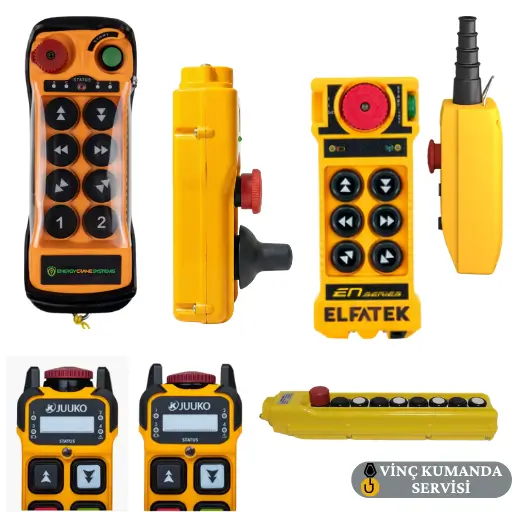
Emergency Stop Button Technical Design
The emergency stop button is a safety component — not a standard control button. Its design requirements are defined precisely by IEC 60947-5-5: red actuator on a yellow background, mushroom-head form factor, mechanical latching mechanism, normally-closed (NC) contact architecture, and minimum IP54 ingress protection. In crane environments, however, IP65 or above is the correct specification because the operating conditions — dust, coolant spray, outdoor exposure — exceed the IP54 threshold that the standard defines as the baseline.
Mechanical Latching
When the emergency stop button is pressed, the contact opens and the button mechanically locks in the pressed position. It cannot be released by the same press — the operator must rotate it clockwise or pull it outward to release the latch and re-enable the system. Consequently, accidental re-activation after an emergency stop event is physically impossible. This is specifically required by EN ISO 13850, which mandates that the emergency stop function cannot self-reset without deliberate manual action.
Fail-Safe NC Contact Architecture
The normally-closed contact architecture means that the emergency stop circuit is fail-safe in the correct engineering sense — any break in the circuit, whether from button activation, cable break, or power loss, causes the system to stop. This is fundamentally different from a normally-open circuit, where a cable break would leave the crane in an uncontrolled state. As a result, the NC design protects against not only intentional activation but also against wiring failures that would otherwise go undetected until an emergency occurs.
Stop Categories: 0 and 1
IEC 60204-1 defines two stop categories relevant to crane remote control systems. Category 0 cuts power immediately — the crane arrests as quickly as mechanical braking allows, without any controlled deceleration sequence. Category 1 first executes a controlled braking sequence, then removes power after the crane has decelerated to a safe condition. The correct category is determined by the crane type and load characteristics, not by preference. For heavy suspended loads, Category 0 produces a mechanical shock load on the hoist structure that Category 1 avoids.
Feedback Indication
Advanced crane remote systems include LED or audible feedback confirming that the emergency stop is active. Furthermore, in wireless remote systems, this status can be mirrored on the transmitter display — allowing the operator to confirm the stop state from their operating position without approaching the receiver unit. This is particularly valuable in large-span crane installations where the receiver may be mounted at significant height.
Legal Requirements and Safety Obligations
A crane remote control without a physical emergency stop button does not comply with the EU Work Equipment Directive (2009/104/EC) or the EU Machinery Directive (2006/42/EC). Any crane system requiring CE marking must satisfy EN ISO 13850. These are not advisory standards — they are the basis on which regulatory compliance is assessed during inspections and on which insurance liability is evaluated following incidents.
Why the Stopping Distance Matters
Bridge cranes typically handle loads between 2 and 80 tonnes. Without a functional emergency stop, the only way to arrest crane motion in an emergency is to wait for the mechanical brake to reach its limit. This is slower, subjects the brake system to abnormal wear, and produces a significantly longer stopping distance than a properly designed emergency stop circuit. Specifically, the difference in stopping distance between a functional emergency stop and a brake-only arrest can be measured in metres — which at crane travel speeds translates directly into personnel exposure time in the hazard zone.
Three Direct Safety Benefits
- Personnel safety: A single button press arrests the crane during load swing, cable failure, or incorrect manoeuvre — reducing the risk of injury to personnel in the crane travel path or load zone.
- Equipment protection: When a software fault occurs in the drive or receiver, the hardware emergency stop circuit overrides the software layer and arrests the crane independently of the control programme.
- Regulatory compliance: Post-incident inspections under occupational health and safety legislation specifically examine whether the crane remote control contains a certified emergency stop mechanism. Non-compliance creates personal liability for the responsible party, not just organisational liability.
Sektöre Göre Stop Kategorisi Seçimi
Acil durdurma stratejisi, vinç tipine ve yük özelliğine göre farklılaşır. Kategori seçimi yanlış yapıldığında ya mekanik hasara (ani duruş) ya da yetersiz güvenliğe (geç duruş) yol açar.
| Sektör / Uygulama | Önerilen Stop Kategorisi | Gerekçe |
|---|---|---|
| Köprülü / tavan vinci | Kategori 1 | Kontrollü frenleme mekanik yükü azaltır, sarkacı önler |
| Portal / gantry vinç | Kategori 0 veya 1 | Rüzgar yükü ve açık alan koşullarına göre belirlenir |
| İnşaat / mobil vinç | Kategori 0 | Yüksek tehlike senaryosunda anlık durdurma önceliklidir |
| Tersane / liman vinci | Kategori 1 | Sarkacı olan yükler için kontrollü duruş zorunludur |
| Fabrika / üretim hattı | Kategori 1 | Üretim sürekliliği için kontrollü duruş tercih edilir |
Stop Category Selection by Crane Type and Application
The emergency stop strategy must match the crane type and load characteristics. Incorrect category selection produces either mechanical damage — from abrupt Category 0 arrests on heavy suspended loads — or insufficient safety response — from a Category 1 sequence that is too slow for the hazard present. However, the selection is not subjective: it follows from the crane’s mechanical design and the nature of the load.
| Application | Recommended Category | Rationale |
|---|---|---|
| Bridge / overhead crane | Category 1 | Controlled braking reduces mechanical load and prevents pendulum swing on suspended loads |
| Gantry / portal crane | Category 0 or 1 | Wind load and open-site conditions determine which is appropriate for the specific installation |
| Mobile / construction crane | Category 0 | High-hazard scenarios require immediate arrest — speed of stopping takes precedence over load protection |
| Shipyard / port crane | Category 1 | Suspended loads require controlled deceleration to prevent pendulum and structural damage |
| Production line crane | Category 1 | Controlled stop preserves production continuity and protects load integrity |
Category 1 requires a VFD (Variable Frequency Drive) to execute the controlled deceleration ramp — consequently, a crane without VFD control cannot implement Category 1 without a drive upgrade. This is a design decision that must be made at system specification stage, not as a retrofit after the emergency stop circuit is already installed.
Emergency Stop and the Watchdog Communication Protocol
In wireless crane remote control systems, emergency stop is triggered by two independent mechanisms — not one. The first is direct button activation by the operator. The second is the watchdog or “dead-man” protocol, which monitors the continuous heartbeat communication between transmitter and receiver. However, it is critical to understand that these two mechanisms are complementary, not alternatives. Standards require both to be present simultaneously.
How the Watchdog Triggers Emergency Stop
The receiver continuously monitors the heartbeat signal from the transmitter. If this signal is absent for a defined period — typically 100 to 500 milliseconds — the receiver treats the communication loss as a safety event and automatically executes the emergency stop sequence. Consequently, battery depletion, the operator moving out of range, or signal interference all trigger the same protective response as a deliberate button press.
Field Misdiagnosis from Watchdog Activation
A watchdog-triggered stop looks identical to a deliberate E-stop from the crane operator’s perspective — the crane arrests and the E-stop indicator activates. As a result, operators frequently attempt to release and reset the emergency stop button when the actual cause is a communication loss rather than button activation. The reset fails, and the system is reported as a faulty emergency stop. In practice, the correct first diagnostic step when a crane stops with an E-stop indication and the button has not been pressed is to check the transmitter battery level and signal reception status — not to inspect the button mechanism.
Emergency Stop Fault Diagnosis: Two Distinct Scenarios
Emergency stop button faults fall into two categories that require different diagnostic approaches. Treating both as the same fault type leads to incorrect component replacement and delayed resolution. Understanding which scenario applies is the first step.
Scenario 1: Button Pressed — Crane Does Not Stop
This is the higher-priority fault because it represents a safety system failure. The emergency stop function is present but non-functional. The diagnostic sequence is:
- Verify that the button NC contact is correctly wired to the receiver’s emergency stop input terminal. After receiver replacement, this connection is the most commonly missed step.
- Measure contact resistance across the NC contact with the button in the normal (unlatched) position — it should read near zero ohms. A high resistance reading indicates contact oxidation or mechanical failure.
- Confirm that the receiver’s E-stop input is configured as an NC input in the receiver parameters. Some receivers allow this to be configured as either NC or NO — if set incorrectly, the NC signal from the button produces no response.
- Check whether the receiver safety relay output is correctly connected to the crane’s power contactor coil circuit. A disconnected safety relay output means the receiver detects the E-stop signal but cannot physically de-energise the crane motion circuit.
Scenario 2: Button Released — System Does Not Resume
This scenario is less urgent but equally disruptive to operations. The emergency stop functioned correctly — the crane stopped — but the system does not return to operational status after the button is released.
- Incomplete latch release: The button requires a firm rotation or pull to release — a partial release leaves the contact partially open. Confirm the button clicks back to its full upward position.
- Watchdog still active: If the communication loss that triggered the stop has not been resolved — low battery, interference still present — the receiver maintains the E-stop state even after the button is physically released. Restore the communication link first, then reset.
- Re-enabling sequence required: Some receivers require a specific reset sequence — such as momentarily pressing a separate “reset” or “enable” button — after an E-stop event before crane operation can resume. Verify the receiver manual for the specific reset procedure.
For the complete fault diagnosis approach across all crane remote control symptom types, see our crane remote control fault signs guide.
Testing Requirements and Maintenance Frequency
IEC 60204-1 requires periodic verification of safety functions — the emergency stop is specifically included. However, the test must be performed under realistic conditions to be valid. A no-load test that produces a crane arrest does not confirm that the emergency stop circuit will function correctly under rated load conditions, where contactor current is higher and the safety relay contact must interrupt a live inductive load.
Recommended Test Frequency and Method
- Every shift / daily: Confirm E-stop button mechanical action — press and confirm latch engagement, then release and confirm return to operating position. This takes under 30 seconds and confirms the mechanical function without requiring a load.
- Weekly: Test under a representative load condition — lift a test load to working height and activate the E-stop. Confirm the crane arrests within the expected distance and the load remains stable after arrest. Document the test result.
- Annually: Full safety function test by the authorised service team — including contact resistance measurement, safety relay response time verification, and cross-monitoring function test where applicable. This annual test is the one that confirms PL-d / SIL 2 compliance is maintained over the system’s service life.
Conclusion
The crane remote control emergency stop button is a safety component defined by IEC 60947-5-5 and EN ISO 13850 — it is not a standard control element, and treating it as one leads to specification errors, testing gaps, and compliance failures. The stop category must match the crane type and load characteristics. The physical button and the watchdog protocol are both required — neither substitutes for the other. Testing must be performed under load conditions, not only at no-load. And after any receiver replacement, the NC contact signal must be re-verified to the new receiver before the crane returns to service. These are not optional precautions — they are the engineering requirements that keep the emergency stop circuit functional throughout the crane’s operational life.
Frequently Asked Questions
Can a crane remote control be used without a physical emergency stop button?
No. EN ISO 13850 and the EU Machinery Directive require every industrial crane remote control to contain a physical emergency stop button with mechanical latching and NC contact architecture. A software-based stop function does not satisfy these requirements and would be identified as non-compliance during a regulatory inspection.
What is the difference between Category 0 and Category 1 emergency stop?
Category 0 immediately cuts power — the crane arrests as fast as mechanical braking allows, with no controlled deceleration. Category 1 first executes a controlled braking sequence via VFD, then removes power after the crane has decelerated safely. Category 1 is preferable for cranes with heavy suspended loads because it prevents the mechanical shock and pendulum swing that Category 0 produces at the moment of arrest.
Why does the crane stop with an E-stop indication when the button was not pressed?
This is almost always a watchdog protocol response to communication loss — not a button circuit fault. If the receiver does not receive the transmitter’s heartbeat signal for the configured timeout period (typically 100–500 ms), it automatically executes the emergency stop sequence. The result looks identical to deliberate button activation. Check the transmitter battery level and signal status before inspecting the button circuit.
Does the watchdog protocol replace the physical emergency stop button?
No. The watchdog protocol is one safety layer — it provides protection against communication failure. The physical emergency stop button is a separate, independent safety layer providing protection against deliberate or situational hazard response. Standards require both to be present simultaneously. Neither is an alternative to the other, and a system with only one of the two does not meet the full safety architecture requirements.
How often should the crane remote control emergency stop be tested?
IEC 60204-1 requires periodic safety function verification. In practice: confirm mechanical button action every shift; test under a representative load condition weekly; and conduct a full circuit test including safety relay response time measurement annually by the authorised service team. A no-load test alone does not confirm that the safety relay contacts will interrupt the load current correctly under rated operating conditions.
Why does the emergency stop button not respond after receiver replacement?
The most common cause is that the NC contact signal from the emergency stop button was not re-wired and re-mapped to the new receiver’s E-stop input terminal during the replacement process. The new receiver has no knowledge of the previous wiring configuration — every connection must be verified, not assumed to be carried over from the old unit. Always perform a loaded E-stop test after any receiver replacement before returning the crane to service.
What does “normally closed” mean for an emergency stop contact?
A normally-closed (NC) contact completes the circuit in its resting, unpressed state. When the button is activated — or when the circuit is broken by a wiring fault or power loss — the contact opens and the circuit is interrupted. This architecture is fail-safe because any circuit failure, including unintended wiring breaks, produces the same protective response as deliberate button activation. A normally-open (NO) contact would not provide this protection, because a broken wire would leave the circuit permanently “unactivated.”
Can I implement Category 1 emergency stop on a crane without a VFD?
No. Category 1 stop requires a Variable Frequency Drive to execute the controlled deceleration ramp before power removal. A crane with direct-on-line motor starters can only implement Category 0 — immediate power removal with no controlled deceleration. If a Category 1 stop is required for the application, a VFD must be part of the crane drive specification. This decision must be made during system design, not as a retrofit after the emergency stop circuit is installed.
What IP rating does a crane remote control emergency stop button need?
IEC 60947-5-5 specifies a minimum of IP54 for emergency stop actuators. However, in crane environments — outdoor applications, dusty production floors, wash-down areas — IP65 is the correct specification. IP54 provides limited water splash protection that is not adequate for environments with directional water jets or heavy dust. A button that fails due to ingress below its rated IP level is a safety system non-compliance, not a maintenance issue.
Is a red mushroom-head button required by standard, or just conventional?
It is required by standard. EN ISO 13850 specifies the red actuator on a yellow background and the mushroom-head form factor as mandatory ergonomic requirements — not aesthetic conventions. The purpose is to ensure the button is identifiable and accessible under stress conditions without visual search. A different colour, shape, or background colour does not meet the standard requirements and would be identified as non-compliant during inspection.
Contact Vinç Kumanda Servisi
Need emergency stop circuit inspection, receiver re-mapping after replacement, or stop category verification for your crane installation? Contact Vinç Kumanda Servisi via WhatsApp at +90 532 546 84 62, email us at info@vinckumandaservisi.com, or visit our contact page for a tailored quote.