Overhead Crane Remote Control Selection: Complete Technical Guide
Selecting the right overhead crane remote control directly determines both operational safety and production efficiency. An incorrect selection — insufficient signal range, mismatched safety certification, or inadequate IP protection for the actual environment — typically becomes apparent within weeks of installation. This guide covers every dimension of overhead crane remote control selection: frequency technology, safety standards, IP rating, ergonomics, button count, speed configuration, battery management, fault diagnosis, and preventive maintenance. Each section delivers the short answer first, followed by the technical detail needed to verify the specification.
Get in Touch for All Your Requirements
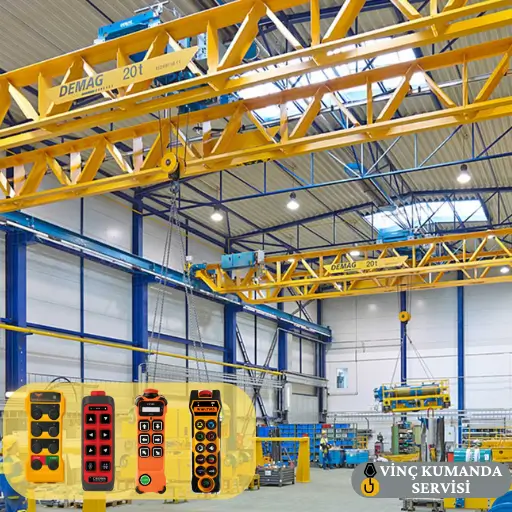
What Is an Overhead Crane Remote Control and Why Is It Required?
An overhead crane remote control is the electronic system that allows an operator to command all crane functions — hoist up/down, bridge travel left/right, trolley travel forward/back — from a handheld transmitter rather than from a fixed control station or pendant cable. The fundamental reason for using remote control rather than a fixed position is operator safety: the operator works from outside the load hazard zone, with a clear sightline to both the crane and the load landing point.
However, the case for remote control is not limited to safety. In large-span overhead crane installations, an operator who can reposition freely while the crane travels maintains continuous sightlines that a pendant operator cannot. As a result, load positioning accuracy improves and the need for a second signal person is eliminated. Both outcomes reduce cycle time and labour cost simultaneously.
Wired Pendant vs Wireless Remote: The Core Differences
A wired pendant constrains the operator to the cable length — typically 5–10 metres from the crane body. This may be adequate for a small, fixed-position lift application. For a large-span overhead crane covering a production floor, however, the cable constraint prevents the operator from following the crane travel and maintaining load visibility. Wireless RF remotes eliminate this constraint entirely, providing 50–100 m effective range that accommodates the full travel path of even large bridge crane installations.
Furthermore, trailing pendant cables on production floors create trip hazards and are vulnerable to forklift traffic damage. Wireless systems remove this maintenance liability completely. For a detailed technical comparison of both systems, see our wired vs wireless crane remote control guide.
Frequency and Signal Technology Selection
Frequency selection is one of the most technically consequential decisions in overhead crane remote control specification — yet it is frequently treated as a secondary consideration. In practice, the wrong frequency band or technology type for the specific operating environment produces interference problems that appear intermittent, are difficult to diagnose, and directly compromise crane safety.
Digital Signal and FHSS Technology
Industrial overhead crane remote controls operate on 433 MHz or 868 MHz frequency bands — both of which are designated as licence-free for industrial use under ETSI short-range device regulations. The 868 MHz band offers a less congested spectrum in industrial environments and is consequently preferable for facilities with multiple active wireless devices.
However, the technology layer matters as much as the band selection. FHSS (Frequency Hopping Spread Spectrum) continuously changes the operating channel within the band — typically hundreds of times per second — making the signal resistant to both fixed-frequency interference and congestion from nearby devices. In facilities with welding equipment, frequency inverters, or multiple crane remotes operating simultaneously, FHSS is a requirement rather than an option. Fixed-frequency systems are appropriate only for single-crane sites with low electromagnetic complexity.
Operating Range and Practical Range Calculation
The nominal range on a product datasheet is measured in open, unobstructed conditions. In practice, enclosed steel-frame buildings reduce this figure by 30–40%. Therefore, calculate your actual required range — the maximum expected distance between the operator and the receiver on the crane — and then specify a system with nominal range at least 50% above this figure. For a 50 m production floor, specify a minimum 75–80 m nominal range system.
Mandatory Safety Features and Standards
For overhead crane applications, safety compliance is not a preference — it is an engineering requirement with legal consequences. The safety features and certification standards listed below are the baseline for any industrial overhead crane installation. However, they are not all automatically confirmed by CE marking alone.
- Emergency stop (E-Stop): A physical mushroom-head button with mechanical latching — red on yellow per ISO 13850. A software button does not meet the requirements of IEC 61508 or ISO 13850 for this safety function. The button must be immediately accessible without repositioning the hand.
- Fail-safe design: On signal loss, battery depletion, or receiver fault, the crane executes a controlled braked stop automatically — without operator action. This is the engineering implementation of the EU Machinery Directive requirement that crane control systems respond safely to any failure condition.
- CE certification: The baseline market access requirement for EU and EU-aligned markets. However, CE alone does not confirm the safety architecture meets PL-d or SIL 2 performance levels.
- ISO 13849-1 (PL-d) documentation: Confirms the redundant safety relay architecture and cross-monitoring performance. Always request this document separately from the CE Declaration of Conformity when evaluating overhead crane remote controls for safety-critical applications.
- ATEX certification: Mandatory in classified explosive atmosphere zones — fuel handling, chemical processing, grain storage, paint spray booths. CE does not substitute for ATEX in these environments.
Ergonomics, IP Protection and Mechanical Durability
Overhead crane operators typically hold the remote control for 8–12 hours per shift. Consequently, unit weight, grip design, and button layout directly affect fatigue level and error rate. Units above 700 g create cumulative arm and wrist fatigue over long shifts. Below this threshold, most operators can use the remote comfortably for a full shift without fatigue-induced errors. Anti-glare displays are essential for facilities with high ambient light — a standard display becomes unreadable in direct sunlight or under bright overhead lighting.
IP Protection Class Selection
The IP protection rating must match the actual operating environment — not a general category. Specifically:
- IP54: Partial dust protection and water splash from any direction. Appropriate for dry, enclosed workshops with minimal contamination. Not adequate for production environments with dust, coolant mist, or regular moisture exposure.
- IP65: Complete dust exclusion and resistance to low-pressure water jets. The minimum specification for standard industrial overhead crane applications, outdoor installations, and any environment with dust or spray.
- IP67: Complete dust exclusion and short-duration submersion resistance. Required for port operations, wash-down facilities, steel foundries, and applications with direct water immersion risk.
Additionally, for outdoor overhead crane installations, UV-stabilised housing material is a separate requirement from IP rating. ABS plastic housings without UV stabilisation develop surface cracking within 2–3 years of continuous sun exposure — compromising the IP seal even though no ingress protection failure has occurred.
How Many Buttons? Single-Speed or Dual-Speed?
Button count and speed configuration are the two most frequently misspecified parameters in overhead crane remote control procurement. Over-specifying button count adds cost and creates accidental activation risk. Under-specifying means a system replacement — not an upgrade — when a missing function is discovered after installation.
Standard Overhead Crane Button Layout
Each crane motion axis requires one button pair — one button per direction. Map every motion axis and auxiliary function before specifying. A standard three-axis overhead crane (hoist, bridge travel, trolley travel) requires a 6-motion (12-button) remote. However, additional functions — secondary hook, rotating hook, drum control, alarm — add further buttons. Confirm all required functions with the crane operator before finalising specification, not after.
Single-Speed vs Dual-Speed: When Does It Matter?
Single-speed controls operate in one speed mode only — full speed or stop. Dual-speed controls add a slow-speed mode, typically at 10–20% of full speed, for precision load positioning. The price premium for dual-speed is typically 20–35% over an equivalent single-speed system. However, this premium is not relevant to every application — only those involving precision placement.
Specifically, dual-speed is the correct specification when: loads must be placed onto fixtures or within tight tolerances; the crane operates in environments where a sudden stop at full speed creates load swing risk; or the application involves threading loads through close clearances. For straightforward horizontal transport with no precision placement requirement, single-speed is adequate and avoids the unnecessary cost premium.
Battery System and Energy Management
Battery depletion during a production shift is an entirely preventable production stoppage. For overhead crane applications in continuous operation, the following battery management requirements apply:
- Minimum 8-hour active-use capacity: The datasheet battery life figure must be verified against active-use conditions — not standby mode, which produces a significantly longer and misleading rating.
- Li-ion chemistry: Li-ion batteries maintain consistent performance in cold environments where NiMH batteries lose capacity. They also complete a higher charge cycle count before degradation. Consequently, Li-ion is the correct specification for any overhead crane application operating in temperatures below +10°C or requiring long battery service life.
- Sleep mode: Automatically reduces power draw after a defined inactivity period. In practice, this extends battery life by 25–30% in operations with regular idle intervals between lifts. Verify that the sleep mode activation delay is configurable — a delay that is too short can cause the remote to sleep during brief operational pauses.
- Low battery warning: Audible or vibration alert gives advance warning before shutdown. The alert should trigger with sufficient remaining capacity to complete an active lift and set down the load safely before the unit depletes.
- Spare battery protocol: Maintain at least one fully charged spare on site for critical crane applications. Station-mounted charging units allow overnight charging of the spare while the main battery is in use, eliminating the risk of starting a shift with an uncharged spare.
Common Faults, Diagnosis and Preventive Maintenance
Overhead crane remote control faults divide into two categories: signal and connection issues, and physical and mechanical failures. Understanding which category a fault belongs to determines the correct first-response action — and prevents the common error of replacing a unit when only a component repair was required.
Signal and Connection Issues
- Intermittent or delayed response: Check battery voltage first — low battery is the most common cause of apparent signal degradation. Then verify receiver antenna orientation. An antenna pointing towards a metal structural member rather than the operating area can reduce effective range by 40–60%.
- Complete loss of signal: Move closer to the receiver and retest. If function returns, the fault is range or antenna orientation. If not, check for EMI sources that may have been added to the facility — new welding equipment, frequency inverters, or additional wireless devices on the same channel.
- Cross-interference with adjacent crane: Establish a channel allocation plan across all active crane remotes on the site. Specify FHSS technology for all new remote systems in multi-crane facilities.
Physical and Mechanical Faults
- Button non-response: Clean button surfaces with a damp cloth and retest in a dry environment. If the problem continues, the button membrane requires replacement. Do not operate with unreliable button response — unpredictable crane movement under load is a direct safety risk.
- Joystick not returning to centre: Take the remote out of service immediately. A joystick that fails to self-centre causes continued crane movement without operator input. This is a service-level repair — do not continue operating the crane until the fault is resolved.
- PCB failure after moisture exposure: A remote that looks undamaged externally may have significant internal board damage from brief water or wash-down exposure. If the unit shows erratic function after any moisture event, treat as a PCB inspection requirement rather than a surface cleaning issue.
Preventive Maintenance Schedule
- Every shift: Battery level check and emergency stop function test before first lift.
- Weekly: Visual inspection of housing for cracks, button surface cleaning with damp cloth, antenna physical check.
- Monthly: Transmitter-receiver synchronisation verification, battery capacity test (compare actual runtime against rated capacity), receiver antenna orientation check.
- Annually: Full safety relay function test, firmware version check against manufacturer’s current release, and IP seal integrity inspection — particularly for units deployed in dusty or wet environments.
For professional repair and service, see our crane remote control repair and technical service page.
Procurement Criteria: What to Verify Before Purchasing
The following checklist covers the specific verification steps required before committing to an overhead crane remote control system. Each item addresses a failure mode that appears regularly in field service calls — and that is entirely avoidable through correct pre-purchase evaluation.
- Crane compatibility confirmed in writing: Share the crane’s contactor wiring diagram and motion axis count with the supplier. Request written compatibility confirmation — not verbal assurance.
- ISO 13849-1 safety assessment document available: Request this document separately from the CE Declaration of Conformity. Its absence means PL-d compliance cannot be confirmed.
- Spare parts held in local stock: Ask specifically about receiver board and safety relay availability and lead time. A supplier who cannot answer promptly does not have the service infrastructure to support the product over its operational life.
- Warranty scope confirmed in writing: The warranty document must specify which components are covered — particularly receiver board and relay modules. Verbal warranty assurances are not sufficient.
- FHSS technology confirmed if multi-crane site: If more than one wireless crane remote will be active on the site simultaneously, FHSS must be confirmed in the technical specification — not assumed.
- Battery rated capacity verified under active-use conditions: Request the active-use battery life figure. Standby ratings are much longer and not representative of real operational duration.
For the complete range of overhead crane remote controls filtered by motion count and brand, see our overhead crane remote controls page.
Conclusion: Five Core Selection Criteria
Overhead crane remote control selection reduces to five criteria that must all be correctly matched to the actual operating conditions: frequency technology (FHSS for multi-crane sites, correct band for the EMI environment), IP protection rating (matched to dust and moisture exposure, not to general crane category), safety certification (CE plus ISO 13849-1 documentation, ATEX where the zone classification requires it), button count and speed configuration (mapped to actual crane functions, dual-speed for precision applications), and battery capacity (8-hour minimum active-use rating, Li-ion for cold environments). A system that satisfies all five correctly will operate reliably for years with predictable maintenance requirements. A system that fails on any one of these criteria generates service calls, safety risks, or operational limitations that the initial cost saving does not justify.
Frequently Asked Questions
How many buttons should I specify for an overhead crane remote?
Count every crane motion axis and auxiliary function — each direction requires one button. A standard three-axis overhead crane (hoist, bridge travel, trolley travel) requires a 6-motion configuration. If additional functions such as secondary hook, alarm, or drum control are needed, add the corresponding buttons. Do not over-specify: unused buttons on the control face create accidental activation risk without any operational benefit.
What is the difference between single-speed and dual-speed crane remote control?
Single-speed controls provide full-speed movement only. Dual-speed controls add a slow-speed mode — typically 10–20% of full speed — for precise load positioning. The price premium is 20–35% over equivalent single-speed. Dual-speed is the correct specification for any application requiring load placement onto fixtures or within defined tolerances. For straightforward transport operations with no precision placement requirement, single-speed is adequate.
Should I choose wired pendant or wireless for an overhead crane?
For most overhead crane applications — particularly large-span bridge cranes where the operator needs to follow the crane travel — wireless is the correct specification. The cable constraint of a wired pendant prevents the operator from maintaining sightlines as the crane moves across the production floor. However, for small, fixed-position cranes in environments with severe EMI that cannot be mitigated by frequency selection, wired remains a valid option.
What IP protection rating is sufficient for an overhead crane remote?
IP65 is the minimum for standard industrial overhead crane environments — it provides complete dust exclusion and water jet resistance. For steel foundries, port operations, or wash-down facilities, IP67 is required. Do not apply a lower rating than the actual environment demands: a single service call caused by premature ingress failure will cost more than the price difference between the correct and incorrect IP rating.
How often should an overhead crane remote control be serviced?
The minimum schedule is: battery and E-Stop check every shift, visual inspection and button cleaning weekly, synchronisation and antenna check monthly, and full safety relay and firmware review annually. In high-cycle or harsh environments, compress this schedule accordingly. Preventive maintenance at these intervals consistently produces lower total service cost than reactive maintenance in response to failures.
How do I prevent signal interference when multiple cranes operate on the same site?
Specify FHSS technology for all crane remotes on the site. FHSS changes the operating channel hundreds of times per second, preventing channel overlap between devices operating simultaneously. Additionally, establish a site-wide channel allocation plan for any fixed-frequency systems that remain in operation during the transition period. For persistent interference from fixed sources such as arc furnaces, 868 MHz band selection reduces susceptibility compared to 433 MHz.
What crane remote control should I use in explosive atmosphere environments?
ATEX-certified remote controls are mandatory in classified explosive atmosphere zones — including fuel handling terminals, chemical processing facilities, paint spray booths, and grain storage silos. ATEX certification is a separate legal requirement from CE marking and addresses the specific risk of ignition from electrical sparking in potentially explosive environments. CE alone does not satisfy ATEX zone requirements. Verify the zone classification of your facility against the ATEX category of the remote control before purchasing.
Contact Vinç Kumanda Servisi
Need help specifying the right overhead crane remote control for your installation, or looking for a compatible system for an existing crane? Contact Vinç Kumanda Servisi via WhatsApp at +90 532 546 84 62, email us at info@vinckumandaservisi.com, or visit our contact page for a tailored recommendation.